- Table View
- List View

Schools, Pupils, and Teachers: Ontario's Educative Society, Volume III
by W. G. FlemingVolume III explores the basic units in the educational system: student, teacher, and school. It examines the aims of education, historically and philosophically, and describes the development of various types of schools. The book provides an analysis of the use of educational media, a description of school buildings and equipment, among many other topics. An important part of the volume is a description of the evolution of the curriculum from the nineteenth century, with a detailed analysis of the changes made in such areas as science, the social sciences, and French.
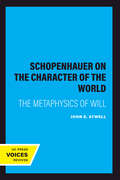
Schopenhauer on the Character of the World: The Metaphysics of Will
by John E. AtwellThe most extensive English-language study of Schopenhauer's metaphysics of the will yet published, this book represents a major contribution to Schopenhauer scholarship. Here, John E. Atwell critically but sympathetically examines the philosopher's main work, The World as Will and Representation, demonstrating that the philosophical system it puts forth does constitute a consistent whole. The author holds that this system is centered on a single thought, "The world is self-knowledge of the will." He then traces this unifying concept through the four books of The World as Will and Representation, and, in the process, dissolves the work's alleged inconsistencies.
Schriftliches Urteilen im Politikunterricht der Sekundarstufe I: Eine Studie zum textsortenbasierten Schreiben im Fachunterricht (Empirische Forschung in den gesellschaftswissenschaftlichen Fachdidaktiken)
by Claudia ForkarthDie vorliegende empirische Studie ist im Kontext des interdisziplinären Forschungsprojekts SchriFT II (Schreiben im Fachunterricht der Sekundarstufe I unter Einbeziehung des Türkischen) entstanden und befasst sich im Rahmen einer quasi-experimentellen Interventionsstudie mit der Wirksamkeit einer textsortenbasierten Schreibförderung im Politikunterricht der Jahrgangsstufen sieben und acht an Gesamtschulen in NRW. Ausgangspunkt sind der textsortenbasierte Lehr-Lern-Zyklus als übergreifendes Interventionskonzept, das (schriftliche) Politische Urteil als fachspezifische Textsorte sowie das Konzept durchgängiger Sprachbildung mit dem Ziel, sprachliches und fachliches Lernen gleichermaßen zu fördern.Neben Interventionseffekten zeigen die Ergebnisse u.a., wie Schüler*innen schriftliche Urteile verfassen und, welche Faktoren einflussreich auf das fachspezifische Schreiben sind.
Schrumpfende Regionen - dynamische Hochschulen
by Michael Fritsch Peer Pasternack Mirko TitzePolitik und andere Akteure in den (vor allem ostdeutschen) Regionen stehen vor der Aufgabe, den demografischen Wandel zu gestalten. Dabei sollen sie zugleich die Voraussetzungen für ,,selbsttragende Entwicklungen" und ,,gleichwertige Lebensverhältnisse" schaffen - und dies unter Bedingungen bis 2020 deutlich abgesenkter Landeshaushalte. Vor dem Hintergrund dieser Herausforderungen werden Optionen für die Regionalentwicklung aufgezeigt, die im Zusammenhang mit Hochschulen stehen.

Schule in Distanz – Kindheit in Krise: Auswirkungen der Covid-19 Pandemie auf Wohlbefinden und Lebensbedingungen von Kindern und Jugendlichen (Erziehungswissenschaftliche Edition: Persönlichkeitsbildung in Schule)
by Jürgen Budde Nora Weuster Tobias Schroedler Drorit Lengyel Caroline Böning Carolina Claus Katharina DodenDer Band überdenkt die gängigen Vorstellungen von guter Kindheit, welche durch die Covid-19 Pandemie in vielfältiger Weise beeinflusst werden. Die Perspektiven von Kindern und Jugendlichen auf die Pandemie noch selten Gegenstand der Diskussion. Thematisch stehen im vorliegenden Band Fragen des Wohlbefindens, der Ungleichheit sowie der Familialisierung des Lernens im Mittelpunkt. Anspruch ist, den Fokus explizit auf die praktischen Lebensbedingungen von Kindern und Familien zu richten und deren Sicht zu stärken.

Schule zwischen Wandel und Stagnation
by Yalız Akbaba Laura FuhrmannDer Band greift die isometrische Bewegung von „Schule zwischen Wandel und Stagnation” auf und bearbeitet die Impulse zum Wandel entlang von gesellschaftlichen Diskursen und tief eingeschriebenen Diskriminierungsstrukturen. Gilt Schule einerseits als träge Institution, in der sich routinisierte Handlungen zu Strukturen verstetigen, ist sie andererseits auch immer von Wandel begleitet: sei es durch beständig an sie herangetragene Anforderungen zur Anpassung an gesellschaftliche Entwicklungen oder Selbstansprüche an sich als lernende Organisation. Im Band wird dieses Wechselspiel über die Betrachtung dreier Ebenen sichtbar gemacht: Von Interesse sind erstens die Strukturen, die sich in der Organisation und Ausgestaltung von Schule zeigen, zweitens der Unterricht, insofern sich diese Strukturen als wirkmächtige Bedingungen des Handelns der schulischen Akteur:innen im Unterrichtsgeschehen erweisen. Drittens richtet sich der Blick mit der Lehrer:innenbildung auf die Ausbildung der pädagogisch Professionellen, die innerhalb der Strukturen agieren und deren Wandel initiieren können. Die theoretischen, empirischen und forschungsmethodischen Beiträge sind Prof.in Dr.in Karin Bräu und ihrem akademischen Werk gewidmet.
Schulentwicklung als Theorieprojekt: Forschungsperspektiven auf Veränderungsprozesse von Schule (Schule und Gesellschaft #61)
by Merle Hummrich Barbara Asbrand Till-Sebastian Idel Anna MoldenhauerDer Band beinhaltet theoretische Analysen der Transformationen von Schule, die sich im Zusammenhang mit gesellschaftspolitischen Herausforderungen, bildungspolitischen Reformen oder einzelschulischen Entwicklungsprozessen ereignen. Vor dem Hintergrund der Annahme, dass Transformationen nicht losgelöst von Tendenzen der Beharrung zu analysieren sind, nehmen die Beiträge des Bandes Kontinuität und Wandel von Schule gleichermaßen in den Blick. Es werden sowohl Möglichkeitsräume als auch Begrenzungen für Schulentwicklung theoretisch ausgeleuchtet.
Schulische Inklusion als Phänomen – Phänomene schulischer Inklusion: Fachdidaktische Spezifika und Eigenlogiken schulischer Inklusion
by Martin Heinrich Bernd Gröben Michael Braksiek Kinga Golus Peter Schildhauer Lilian StreblowDas Buch liefert einen Einblick in fachbezogene Inklusionsdiskurse in nahezu jeder Fachdidaktik. Zudem werden für die jeweiligen Fachdidaktiken „typische“ Phänomene schulischer Inklusion herausgearbeitet und beispielhaft illustriert. Im Durchgang durch die unterschiedlichen fachdidaktischen „Aneignungsformen“ des bildungspolitischen Impulses der UN-BRK zur Institutionalisierung eines inklusiven Schulsystems zeigt sich, dass die disziplinären Eigenlogiken der Fächer durchaus wirksam sind, zugleich aber vielfältige schulpraktische Lösungen angeboten werden. So bietet das Buch insgesamt eine Synopse des fächerspezifischen Inklusionsdiskurses als Antwort auf die governanceanalytische Frage: „Was implementiert sich da eigentlich?“
Schulische und außerschulische politische Bildung: Qualitative Studien und Unterrichtsbeispiele hermeneutischer Politikdidaktik (Politische Bildung)
by Carl Deichmann Marc PartetzkeDer Sammelband widmet sich in zehn Beiträgen dem Zusammenhang zwischen der Zielbestimmung der schulischen und außerschulischen politischen Bildung sowie der Praxis in diesen Lernbereichen. Diese Zusammenhänge werden an signifikanten Beispielen herausgestellt und durch qualitative Forschung belegt. So erhalten Praktiker der schulischen und außerschulischen politischen Bildung durch dieses Buch nicht nur Anregungen für ihre Tätigkeit durch Unterrichts- und Seminarbeispiele, sondern werden durch konkrete Beispiele auch dazu angeregt, ihre Aktivitäten in Unterricht und Seminaren zu planen und zu evaluieren.Der Inhalt• Politikdidaktische Forschung: Zusammenhang von hermeneutischer Politikdidaktik und Politikunterricht; Urteilskompetenz; demokratisch-politische Bildung als Gegenstand universitärer Lehramtsausbildung• Konzepte des Politikunterrichts/der Unterrichtsforschung: Personenbezogene Geschichtspolitik im Politikunterricht; „Denkhüte“ im Politikunterricht; Demokratiepräkonzepte bei Schüler*innen• Außerschulische politische Bildung: Historische Lernorte politisch verstehen; Politische Lernorte; Politische Bildung in der offenen Kinder- und JugendarbeitDie HerausgeberDr. Carl Deichmann ist Univ. - Professor em. für Didaktik der Politik und zurzeit Lehrbeauftragter an der Friedrich-Schiller-Universität Jena.Dr. Marc Partetzke ist Universitätslektor für Politikwissenschaft und ihre Didaktik am Institut für Politikwissenschaft der Universität Bremen.
Schulleitungen im institutionellen Zielvereinbarungsprozess: Handlungsleitende Orientierungen von Schulleiter*innen zwischen alten und neuen Steuerungsvorstellungen (Rekonstruktive Bildungsforschung #50)
by Juliane KeitelInstitutionelle Zielvereinbarungen gehören zum Instrumentarium der sog. Neuen Steuerung, das seit Anfang der 2000er Jahre Eingang ins Schulsystem fand. Zielvereinbarungen werden im Anschluss an externe Schulevaluationen zwischen Schule und Schulaufsicht geschlossen. Sie sind mit bildungspolitischen Steuerungsabsichten verbunden, unter anderem werden die Nutzung der Evaluationsberichte an den Schulen und der Abbau von Hierarchien zwischen Schulaufsicht und Schulen erwartet. Schulleitungen obliegt die Aufgabe, das Instrument - das sich einer pädagogischen Sinnstiftung systematisch entzieht - dennoch anschlussfähig an die schulische Praxis zu gestalten. Mithilfe der Dokumentarischen Methode wurden handlungsleitende Orientierungen von 20 Schulleitungen unterschiedlicher Schularten, die einen Zielvereinbarungsprozess durchlaufen haben, rekonstruiert und eine sinngenetische Typologie erstellt. Diese gibt nicht nur Auskunft über die konjunktiven Erfahrungsräume von Schulleitungen im Transformationsprozess, sondern liefert einen spezifischen Beitrag zu professionstheoretischen Überlegungen für die Schulleitungstätigkeit.

Schulpraktische Lehrerprofessionalisierung als Ort der Zusammenarbeit
by Hans-Stefan Siller Lina PilypaitytėIm Sammelband werden wichtige Impulse aus den verschiedenen Bereichen der Lehrerbildung – Hochschule, Studienseminar und Schule – vernetzt und es wird eine Bestandsaufnahme zur Zusammenarbeit der an der Lehrerbildung Beteiligen vorgenommen. Als ein erfolgsversprechender Ansatz für die Kommunikation auf Augenhöhe werden hybride Räume der Zusammenarbeit in den Fokus genommen. Mit einem Schwerpunkt auf die schulpraktische Lehrerprofessionalisierung werden verschiedene Formen und Aspekte der Zusammenarbeit thematisiert. Ziel ist es, Möglichkeiten zur Weiterentwicklung und erweiterte Kommunikationsräume aufzuzeigen. Im Buch werden Forschungsergebnisse und Impulse aus zahlreichen Projekten vorgelegt bzw. vorgestellt.
Schulsysteme beschreiben und gestalten: Bildungsmonitoring in der Schweiz (Educational Governance #54)
by Flavian ImligIn diesem Open-Access-Buch werden die folgenden Fragen untersucht: Was bedeutet Bildungsmonitoring in der Schweiz? Welche Erwartungen und Zielsetzungen werden damit verbunden, welche Instrumente etabliert, welche Produkte vorgelegt? Das Buch zeigt, wie und durch welche Akteure mit welchen Interessen die Dauerbeobachtung der Bildungssysteme in den letzten 30 Jahren maßgeblich umgebaut wurde. Bildungsmonitoring wird dabei als Instrument der politischen Kommunikation dargestellt.

Schumpeterian Analysis of Economic Catch-up
by Keun LeeOne of the puzzles about why some countries have stronger economic growth than others revolves around the so-called 'middle-income trap', the situation in which a country that has grown strongly gets stuck at a certain level. In this book, Keun Lee explores the reasons why examples of successful catching-up are limited and in particular, why the Asian economies, including China, have managed to move, or are moving, beyond middle-income status but economic growth has stalled in some Latin American countries. This is one of the first studies to demonstrate using patent analysis that the secret lies in innovative systems at the firm, sector and country levels which promote investment in what the author calls 'short-cycle' technologies and thereby create a new path different from that of forerunning countries. With its comprehensive policy framework for development as well as useful quantitative methods, this is essential reading for academic researchers and practitioners.
Schutz Kritischer Infrastrukturen in Deutschland: Implementation zum Infrastrukturschutz an Verkehrsflughäfen
by Eva K. PlatzerDer Schutz von kritischen Infrastrukturen spielt eine entscheidende Rolle bei der Aufrechterhaltung täglicher Dienstleistungen und schützt sowohl die Bevölkerung als auch die nationale Wirtschaft eines Landes. Bisher ist die Policy zum Schutz Kritischer Infrastrukturen freiwillig. Ihre Implementation hängt vom Betreiber der Kritischen Infrastruktur ab. Im Zuge der Corona-Pandemie wurden Maßnahmen ergriffen, die zu Veränderungen der Policy-Inhalte geführt haben. Zudem führt das (aktuell im Entwurf befindliche) KRITIS-Dachgesetz zu einer grundlegenden Novellierung der Policy. Dies macht eine eingehende Analyse des Status quo der Implementation durch die Betreiber erforderlich. Die qualitative Untersuchung dieser Arbeit vergleicht anhand von drei Fallstudien die Umsetzung der Policy zum Schutz Kritischer Infrastrukturen an deutschen Verkehrsflughäfen. Die Kernfragen sind dabei: Wie wird die Policy implementiert und wie lässt sich dies erklären?
Schädliche traditionelle und kulturelle Praktiken im internationalen und regionalen Menschenrechtsschutz (Beiträge zum ausländischen öffentlichen Recht und Völkerrecht #281)
by Romy KlimkeDieses Buch befasst sich aus menschenrechtlicher Perspektive mit einer Vielzahl von Bräuchen und Riten, die als soziale Phänomene unter dem Begriff der "schädlichen traditionellen und kulturellen Praktiken" zusammengefasst werden können. Schädliche traditionelle und kulturelle Praktiken stehen heutzutage mehr denn je im Fokus öffentlicher Debatten. Angesichts der wachsenden kulturellen Vielfalt werden öffentliche Auseinandersetzungen über neue und alte Traditionen, "fremde" und "eigene" soziokulturelle Praktiken als auch die Grenzen von sozialadäquaten Selbst- und Fremdschädigungen weiter zunehmen. Die vorliegende Abhandlung erfasst und bewertet schädliche traditionelle und kulturelle Praktiken erstmals systematisch als ein universelles Phänomen und untersucht ihre menschenrechtlichen Implikationen. Damit leistet sie nicht zuletzt einen wichtigen Beitrag zur Förderung eines glaubwürdigen Menschenrechtsdiskurses innerhalb unserer heutigen pluralistischen Gesellschaften.
Science & Resources: Prospects and Implications of Technological Advance (RFF Policy and Governance Set)
by Henry JarrettFirst Published in 2011. Routledge is an imprint of Taylor & Francis, an informa company.

Science Advice to the President: To The President, Congress And Judiciary
by Jack WerberThis is a provocative, behind-the-scenes introduction to the vital and complex role science plays in United States politics. It includes the first formal statement from former President Clinton's former Science Advisor, John H. Gibbons; a fresh retrospective from D. Allan Bromley on science advice in the George H. W. Bush Administration; and a unique viewpoint from John McTague about his brief tenure under President Reagan. Among the twenty-four contributors are former members of the President's Science Advisory Committee, distinguished scholars, and industrialists.
Science And Technology For America's Progress: Ensuring The Best Presidential Appointments In The New Administration
by National Academy Of Sciences National Academy of Engineering Institute of Medicine of the National AcademiesThe new Obama administration and the 110th Congress elected in November 2008 will face immediate challenges. Events will not permit a leisurely leadership transition. The prompt appointment of a Presidential science adviser and the nomination of top officials in the new administration with the knowledge and experience to address complex problems will be essential. The concerns of the nation regarding jobs and economic growth, health care, national security, energy, and the environment demand informed action. Each of these concerns-from national security, economic development, health care, and the environment, to education, energy, and natural resources-is touched in essential ways by the nation's science and technology enterprise. This is the fourth in a series of books from the National Academies on the presidential appointment process, each delivered during a presidential election year with the goal of providing recommendations to the President-elect about appointing his senior science and technology leadership and pursuing sustained improvements in the appointments process.
Science And Technology For Army Homeland Security: Report 1
by Committee on Army Science Technology for Homeland DefenseThe confluence of the September 11, 2001 terrorist attack and the U.S. Army’s historic role to support civil authorities has resulted in substantial new challenges for the Army. To help meet these challenges, the Assistant Secretary of the Army for Research and Technology requested the National Research Council (NRC) carry out a series of studies on how science and technology could assist the Army prepare for its role in homeland security (HLS). The NRC’s Board on Army Science and Technology formed the Committee on Army Science and Technology for Homeland Security to accomplish that assignment. The Committee was asked to review relevant literature and activities, determine areas of emphasis for Army S&T in support of counter terrorism and anti-terrorism, and recommend high-payoff technologies to help the Army fulfill its mission. The Department of Defense Counter-Terrorism Technology Task Force identified four operational areas in reviewing technical proposals for HLS operations: indications and warning; denial and survivability; recovery and consequence management; and attribution and retaliation. The study sponsor asked the Committee to use these four areas as the basis for its assessment of the science and technology (S&T) that will be important for the Army’s HLS role. Overall, the Committee found that: - There is potential for substantial synergy between S&T work carried out by the Army for its HLS responsibilities and the development of the next generation Army, the Objective Force. - The Army National Guard (ARNG) is critical to the success of the Army’s HLS efforts.
Science And Technology In The National Interest: Ensuring The Best Presidential And Federal Advisory Committee Science And Technology Appointments
by Institute of Medicine National Academy of Engineering Institute of Medicine of the National AcademiesIn 2004, an ad hoc committee was charged with preparing this third report examining the most senior S&T appointments to federal government positions and updating the accompanying list of the most urgent S&T presidential appointments. Sufficient changes have occurred since the National Academies 2000 report on presidential appointments—including the 2001 terrorist attacks, the anthrax deaths, the reorganization of homeland-security activities in the federal government, new developments in S&T, and concerns about the politicization of S&T decision making and advice—to warrant this new edition. In contrast with previous reports on the subject, this one covers not only presidential appointments to top S&T leadership positions but also the appointment of scientists, engineers, and health professionals to serve on federal advisory committees that focus on science-based policy or on the review of research proposals. The committee recognizes that other areas of federal responsibility are as important as S&T, but S&T appointments are the only ones within its purview.
Science Competes: Informing Policy in a Time of Distrust, Fracture, and Chaos (Information Policy)
by Barry BozemanWhen science competes with myriad influences in public policymaking, how can we ensure that it does so effectively?Policymakers, like most people today, have a world of information within easy reach, much of it wrong. How, amid the chaos and misdirection of our day&’s information ecosystem, can science compete for the attention and trust of those who make public policy—especially at a time when issues like proliferating infectious diseases and climate change put a premium on accurate and relevant scientific information? What&’s needed, Barry Bozeman suggests in Science Competes, is a clearer understanding of how scientific information is conveyed, how it is understood and used, and where it fits in the wide array of information that might be of use to those who make and administer policy, laws, and regulations, as well as citizens who actively participate in public life.Acknowledging the importance of different sorts of information—historical, experiential, political—to decision-making, Bozeman focuses on enhancing, not maximizing, the effective use of science in public policy. This entails recognizing that valid and useful scientific information is not necessarily formal scientific knowledge, but often takes the form of science by-products such as raw or structured data, graphics, and conceptual models. Explaining how such information can be better distinguished from half-truths and pernicious falsehoods, Science Competes also raises the possibility that effective competition might require improvements in science institutions, norms, and ideas about acceptable behavior.
Science Diplomacy for South Asian Countries: Insights and Breakthroughs
by Malti GoelThis book provides a science diplomacy outlook as a new governance tool in international cooperation. It elaborates on India's current S&T collaboration with Afghanistan, Bangladesh, Bhutan, Maldives, Myanmar, Nepal, Pakistan, Sri Lanka, and science policy and science diplomacy in India. The book introduces concepts and contours of science diplomacy with international examples. It presents insights into international governance models, mega-science projects, and science diplomacy's role in addressing global climate change and sustainable development challenges. The book is a valuable reference to spark breakthroughs in India’s science diplomacy with its neighbouring countries for scientists, diplomats, policymakers, government, and non-government institutions interested in science and diplomacy.
Science Diplomacy, Cyberdiplomacy and Techplomacy in EU-LAC Relations (United Nations University Series on Regionalism #25)
by Shaun Riordan Mario Torres JarrínThis book explores collaborations between the European Union (EU) and the CELAC ( Community of Latin American and Caribbean States) in science diplomacy, as well as the related areas of cyberdiplomacy and techplomacy. It focuses on how interregional collaboration could strengthen societal resilience in both LAC and EU member countries and contribute to realising the SDGs and Agenda 2030 objectives. The book explores the history of EU relations with LAC, and provides a conceptual basis for science diplomacy, including cyberdiplomacy and techplomacy in the context of international relations and diplomacy studies. It highlights how COVID-19 has accelerated pre-existing trends in diplomacy in EU and LAC, forcing diplomats online and making them confront scientific and technical issues as core parts of foreign policy agendas and future pandemic preparedness. The book also examines the role of science diplomacy between these regions in relation to the climate change debate and reflects on whether the EU-LAC collaboration in science and R&D can be taken to a policy level. It provides suggestions on ways in which the CELAC and the EU could collaborate, both in promoting a ruled-based cyberspace and in strengthening digital resilience, and situates this collaboration in the broader geopolitical, scientific and technological environments. Authored by experts in this field, this highly topical book is of interest to a wide readership interested in diplomacy studies, public policy, international relations, regionalism, and S&T studies.
Science Diplomacy: New Day or False Dawn
by Lloyd Spencer Davis Robert G. PatmanAs modern foreign policy and international relations encompass more and more scientific issues, we are moving towards a new type of diplomacy, known as “Science Diplomacy”. Will this new diplomacy of the 21st century prove to be more effective than past diplomacy for the big issues facing the world, such as climate change, food and water insecurity, diminishing biodiversity, pandemic disease, public health, genomics or environmental collapse, mineral exploitation, health and international scientific endeavours such as those in the space and the Antarctic? <P><P>Providing a new area of academic focus that has only gathered momentum in the last few years, this book considers these questions by bringing together a distinguished team of international specialists to look at various facets of how diplomacy and science are influenced by each other.The book not only dissects the ways that politics, science and diplomacy have become intertwined, but also highlights how the world's seemingly most intractable problems can be tackled with international collaboration and diplomacy that is rooted in science, and driven by technology. It, therefore, challenges the conventional wisdom concerning the juxtaposition of science and the world of diplomacy.
Science Education for Sustainable Development in Asia (Education Innovation Series)
by Hiroki Fujii Sun-Kyung LeeThis book presents an Asian perspective on transformative science education in the context of the United Nations' Sustainable Development Goals (SDGs). The chapters are written by contributors who practiced science education for sustainability in a research project entitled “Teacher Education for ESD in the Asia-Pacific Region” from 2017 to 2019, supported by the Japan Society for the Promotion of Science, and the Japanese National Commission for UNESCO. The book showcases the contributors’ innovations in science education for sustainability, presenting case studies of science teaching and learning, science curriculum and assessment, science education in collaboration with local communities, and science teacher education. Embodying Asian sustainability education paradigms, policies, and practices, these case studies depict the diversity and uniqueness of natural, social, and cultural contexts in Asia, while demonstrating their commonalities. Through examining these case studies, this book aims to provide examples for praxis, and prospects, for new science classes, curricula, and teacher education in implementing education for sustainable development.