- Table View
- List View
Skin Cancer: Pathogenesis and Diagnosis
by Ratan Singh Ray Ashish Dwivedi Abhishek Kumar Singh Anurag TripathiThis book highlights the molecular and cellular mechanisms involved in the initiation and progression of skin cancer. It also explains the role of the environment in skin cancer development and explores the potential of microbiome in the diagnosis, prevention and treatment of skin cancer. The book also presents potential biomarkers for early detection of skin cancer and discusses recent advances in skin cancer prevention and treatment using photodynamic therapy. Lastly, it summarizes the applications of biomedical engineering, non-coding and nanotechnology in the diagnosis and therapeutics in skin cancer. It is a valuable resource for investigators in the field of skin cancer, including pathologists, medical and surgical oncologists, and dermatologists.
Skin Deep
by Margaret. HallEven if you have pimples, your skin is still amazing! Read this book and learn all about the largest organ in your body.
Skin Deep: Journeys in the Divisive Science of Race
by Gavin EvansEverything you need to know about race (but were afraid to ask). MYTH: Early Europeans were white. REALITY: The first Europeans had dark skin, black, curly hair and blue eyes. MYTH: Between 50,000 and 70,000 years ago, a &‘cognitive revolution&’ led to the birth of culture in Europe. REALITY: Modern intelligence evolved tens of thousands of years earlier, leading to the birth of culture in Africa.Does racism have a rational basis in science? In Skin Deep, Gavin Evans tackles head-on the debate that has been raging on internet message boards and in academic journals. No longer limited to the fringe, race-based studies of intelligence have been discussed by thinkers such as Sam Harris and Jordan Peterson. If these studies were true, they would provide an intellectual justification for inequality and discrimination. Examining the latest research on how intelligence develops and laying out new discoveries in genetics, palaeontology, archaeology and anthropology to unearth the truth about our shared past, Skin Deep demolishes the pernicious myth that our race is our destiny and instead reveals what really makes us who we are.
Skin Stem Cells
by Kursad TurksenDuring the last decade, an increased interest in somatic stem cells has led to a flurry of research on one of the most accessible tissues of the body: skin. Much effort has focused on such topics as understanding the heterogeneity of stem cell pools within the epidermis and dermis, and their comparative utility in regenerative medicine applications. In Skin Stem Cells: Methods and Protocols, expert researchers in the field detail many of the methods which are now commonly used to study skin stem cells. These include methods and techniques for the isolation, maintenance and characterization of stem cell populations from skin. Written in the highly successful Methods in Molecular BiologyTM series format, chapters include introductions to their respective topics, lists of the necessary materials and reagents, step-by-step, readily reproducible laboratory protocols, and key tips on troubleshooting and avoiding known pitfalls. Authoritative and practical, Skin Stem Cells: Methods and Protocols seeks to aid scientists in the further understanding of these diverse cell types and the translation of their biological potential to the in vivo setting.
Skin Stem Cells: Methods and Protocols (Methods in Molecular Biology #1879)
by Kursad TurksenThis detailed book collects new and updated techniques that will help to improve our understanding of the mechanisms underlying stem cell-derived repair through stem cells of the epidermal and dermal lineages, which have led to the isolation of numerous stem cell-like sub-populations from the epidermis and dermis. Written for the highly successful Methods in Molecular Biology series, chapters include introductions to their respective topics, lists of the necessary materials and reagents, step-by-step, readily reproducible laboratory protocols, and tips on troubleshooting and avoiding known pitfalls. Comprehensive and practical, Skin Stem Cells: Methods and Protocols, Second Edition serves as a valuable assemblage of protocols for researchers both already working in the field and those who now wish to newly embark on studies of skin stem cells.
Skin Stem Cells: Methods and Protocols (Methods in Molecular Biology #2849)
by Kursad TurksenThis updated edition explores techniques in identifying and characterizing various skin stem cells and generating skin-like structures in vitro. The goal of the book is to present exciting advances in skin biology in an effort to provide a better understanding of skin and, eventually, to allow us to regenerate skin with its original form and function. Written for the highly successful Methods in Molecular Biology series, chapters include introductions to their respective topics, lists of the necessary materials and reagents, step-by-step and readily reproducible laboratory protocols, and tips on troubleshooting and avoiding known pitfalls. Authoritative and up-to-date, Skin Stem Cells: Methods and Protocols, Third Edition serves as a valuable assemblage of protocols for researchers already working in the field and for those who now wish to newly embark on studies of skin stem cells.
Skin Theory: Visual Culture and the Postwar Prison Laboratory
by Cristina Mejia VisperasHonorable Mention, Rachel Carson Prize, given by the Society for the Social Studies of ScienceFinalist, 2023 ASAP Book Award, given by the Association for the Study of the Arts of the PresentStudies the intersections of incarceration, medical science, and race in postwar AmericaIn February 1966, a local newspaper described the medical science program at Holmesburg Prison, Philadelphia, a “golden opportunity to conduct widespread medical tests under perfect control conditions.” Helmed by Albert M. Kligman, a University of Pennsylvania professor, these tests enrolled hundreds of the prison’s predominantly Black population in studies determining the efficacy and safety of a wide variety of substances, from common household products to chemical warfare agents. These experiments at Holmesburg were hardly unique; in the postwar United States, the use of incarcerated test subjects was standard practice among many research institutions and pharmaceutical companies. Skin Theory examines the prison as this space for scientific knowledge production, showing how the “perfect control conditions” of the prison dovetailed into the visual regimes of laboratory work. To that end, Skin Theory offers an important reframing of visual approaches to race in histories of science, medicine, and technology, shifting from issues of scientific racism to the scientific rationality of racism itself. In this highly original work, Cristina Mejia Visperas approaches science as a fundamentally racial project by analyzing the privileged object and instrument of Kligman’s experiments: the skin. She theorizes the skin as visual technology, as built environment, and as official discourse, developing a compelling framework for understanding the intersections of race, incarceration, and medical science in postwar America.
Skin Tissue Engineering: Methods and Protocols (Methods in Molecular Biology #1993)
by Sophie Böttcher-Haberzeth Thomas BiedermannThis volume provides protocols describing the isolation and culture of diverse cell types stemming from the skin and the use of these cells and cell constructs for wound healing, bioengineering applications, and translational medicine purposes. The book is divided into three sections describing the isolation and culture of diverse skin cells, managing these cells within co-culture systems and skin models, as well as using these skin models in a test setting. Written for the highly successful Methods in Molecular Biology series, chapters include introductions to their respective topics, lists of the necessary materials and reagents, step-by-step, readily reproducible laboratory protocols, and tips on troubleshooting and avoiding known pitfalls. Authoritative and practical, Skin Tissue Engineering: Methods and Protocols serves as a vital aid to basic and clinical researchers such as biologists, physicians, and biomedical engineers working with and being interested in basic science, and clinically and laboratory-applicable translational regenerative medicine.
Skin Tissue Engineering: Methods and Protocols (Methods in Molecular Biology #2922)
by Sophie Böttcher-Haberzeth Thomas BiedermannThis second volume provides protocols describing the isolation and culture of diverse cell types stemming from the skin and the use of these cells and cell constructs for wound healing, bioengineering applications, and translational medicine purposes. Chapters describe the isolation, culture of diverse skin cells, skin models, and managing these cells within co-culture systems. Written in the highly successful Methods in Molecular Biology series format, the chapters include brief introductions to the material, lists of necessary materials and reagents, step-by-step, readily reproducible laboratory protocols, and a Notes section which highlights tips on troubleshooting and avoiding known pitfalls. Authoritative and cutting-edge, Skin Tissue Engineering: Methods and Protocols, Second Edition aims to be comprehensive guide for researchers in the field.
Skincare Decoded: The Practical Guide to Beautiful Skin
by Victoria Fu Gloria LuDepending on who you listen to, the secret to beautiful skin is microbiomes. Or Korean rice water. Or maybe a dermaplaning tool. It feels like you need a degree in chemistry to even understand what these products are, and if they live up to the hype. Luckily, Victoria Fu and Gloria Lu, professional skincare chemists have done that work so you don&’t have to. The science may seem complicated, but this book will show you how simple it can be, giving you what you need to make informed decisions about your skin (and your wallet). Skincare Actives? Technically, cat sneezes could count. SPF? Yep, super important. Caffeine serums? The science is still out. CBD additives? Not enough studies yet, so the jury&’s still out. The authors are the creators behind the popular Chemist Confessions Instagram, and this book brings the sass, humor, and solid inLayoution they&’re known for. Additional chapters address the best ingredients for every skin type, and reveal the only four products you really need.
Skull Base Imaging: The Essentials
by F. Allan Midyett Suresh K. MukherjiThis book is a comprehensive guide to skull base imaging. Skull base is often a “no man’s land” that requires treatment using a team approach between neurosurgeons, head and neck surgeons, vascular interventionalists, radiotherapists, chemotherapists, and other professionals. Imaging of the skull base can be challenging because of its intricate anatomy and the broad breadth of presenting pathology. Although considerably complex, the anatomy is comparatively constant, while presenting pathologic entities may be encountered at myriad stages. Many of the pathologic processes that involve the skull base are rare, causing the average clinician to require help with their diagnosis and treatment. But, before any treatment can begin, these patients must come to imaging and receive the best test to establish the correct diagnosis and make important decisions regarding management and treatment. This book provides a guide to neuoradiologists performing that imaging and as a reference for related physicians and surgeons. The book is divided into nine sections: Pituitary Region, Cerebellopontine Angle, Anterior Cranial Fossa, Middle Cranial Fossa, Craniovertebral Junction, Posterior Cranial Fossa, Inflammatory, Sarcomas, and Anatomy. Within each section, either common findings in those skull areas or different types of sarcomas or inflammatory conditions and their imaging are detailed. The anatomy section gives examples of normal anatomy from which to compare findings against. All current imaging techniques are covered, including: CT, MRI, US, angiography, CT cisternography, nuclear medicine and plain film radiography. Each chapter additionally includes key points, classic clues, incidence, differential diagnosis, recommended treatment, and prognosis. Skull Base Imaging provides a clear and concise reference for all physicians who encounter patients with these complex and relatively rare maladies.
Sky Gazing: A Guide to the Moon, Sun, Planets, Stars, Eclipses, and Constellations
by Meg ThacherThe sun, moon, stars, and planets have been a source of wonder and fascination for as long as humans have inhabited the earth. In Sky Gazing, a highly visual guide to observing the sky with the naked eye, kids aged 9–14 will delve into the science behind what they see, whether they live in a dark rural setting or under the bright lights of the city. Exploring astronomical objects and events, this captivating book takes young readers on a tour of our solar system and deep space beyond, with explanations of how objects like Earth&’s moon were formed and the &“why&” behind phenomena such as eclipses, northern lights, and meteor showers. Curious sky gazers will discover how to find and observe planets — no binoculars or telescopes required! — and star charts will guide them in spotting constellations throughout the seasons and in both hemispheres while they learn about constellation myths from cultures around the world. Activities include tracking the cycles of the sun and moon and observing the sky during daylight hours or on a cloudy night, while astronomer profiles and sidebars on space technology and current issues such as light pollution help ground kids&’ discoveries in the ancient and enduring science of studying the sky.
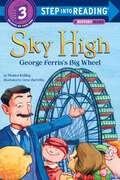
Sky High: George Ferris's Big Wheel (Step into Reading)
by Monica KullingThis fascinating Step 3 History Reader describes the invention of the first Ferris wheel—an engineering marvel. The 1893 World&’s Fair organizers wanted something big to draw people to Chicago . . . something that would rival the Eiffel Tower. George Ferris, an American engineer, had the idea for an observation wheel that passengers could ride on. People laughed at his idea. They said it would never work. But it was a huge success, with thirty-six cars that could hold over 2,100 riders! That&’s some big wheel! Ferris wheel lovers can thank George Ferris for never giving up his dream. Step 3 Readers feature engaging characters in easy-to-follow plots about popular topics—for children who are ready to read on their own.
Sky Jumpers Book 2: The Forbidden Flats
by Peggy EddlemanEscape one danger. Jump into another. . . . Twelve-year-old Hope has always felt a little different from everyone else who lives in White Rock. She tries hard, but she doesn't always think before she acts. She takes big risks. Sometimes her risks pay off, but sometimes they fail. Sometimes she fails. Hope knows that the most dangerous thing about living in White Rock is that it's so close to the deadly Bomb's Breath--the invisible, fifteen-foot-thick band of compressed air that's hovered over the earth since the Green Bombs of World War III. The citizens of White Rock live in fear of the Bomb's Breath. Only Hope has figured out a way to go through it--and lived to tell the tale. But when a massive tremor rips across the earth, the Bomb's Breath begins to lower over White Rock. It's up to Hope and her friends Brock and Aaren to make the dangerous journey far from home, across the bandit-ridden Forbidden Flats to the wilds of the Rocky Mountains, and obtain the one thing that may be able to stop it--before the Bomb's Breath sinks too far and destroys them all. This time, Hope can't fail. From the Hardcover edition.
Sky Jumpers: Book 1 (Sky Jumpers #1)
by Peggy EddlemanWhat happens when you can't do the one thing that matters most? Twelve-year-old Hope Toriella lives in White Rock, a town of inventors struggling to recover from the green bombs of World War III. But Hope is terrible at inventing and would much rather sneak off to cliff dive into the Bomb's Breath--the deadly band of compressed air that covers the crater left by the bombs--than fail at yet another invention. When bandits discover that White Rock has priceless antibiotics, they invade. With a two-day deadline to finish making this year's batch and no ingredients to make more, the town is left to choose whether to hand over the medicine and die from the disease that's run rampant since the bombs, or die fighting the bandits now. Help lies in a neighboring town, but the bandits count everyone fourteen and older each hour. Hope and her friends--Aaron and Brock--might be the only ones who can escape to make the dangerous trek through the Bomb's Breath and over the snow-covered mountain. Inventing won't help her make it through alive, but with Aaron and Brock's help, the daring and recklessness that usually gets her into trouble might just save them all.

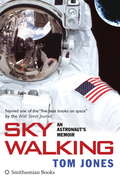
Sky Walking: An Astronaut's Memoir
by Tom JonesA gripping first-hand account of life in space and the making of an astronaut. What is it like to fly the space shuttle and work on and in the International Space Station? <p><p>Veteran NASA astronaut Tom Jones is uniquely qualified to give the details: he flew four shuttle missions and led three space walks to deliver the US Lab to the Station. From B-52 pilot during the Cold War, to a PhD in planetary science, to the unbelievable rigors of astronaut training, his career inevitably pointed him toward the space shuttle. Until the Challenger exploded. <p><p>Jones's story is the first to candidly explain the professional and personal hardships faced by the astronauts in the aftermath of that 1986 tragedy. He certainly has 'The Right Stuff' but also found himself wondering if the risks he undertook were worth the toll on his family. Liftoffs were especially nerve-wracking (his mother, who refuses to even get on a plane, cannot watch) but his 53 days in space were unforgettable adventures. <p><p>Jones uses his background as a scientist to explain the practical applications of many of the shuttle's scientific missions, and describes what it's like to work with the international crews building and living aboard the space station. Tom Jones returned from his space station voyage to assess the impact of the 2003 Columbia tragedy, and prescribes a successful course for the U.S. in space. Stunning photographs, many taken in space, illustrate his amazing journey.
Sky Watcher #5 (Jada Jones #5)
by Kelly Starling LyonsJada Jones is back for the fifth book of this popular, celebrated series perfect for STEM fans!"Readers who love Ivy and Bean or Katie Woo will want to meet Jada Jones." --School Library JournalJada is excited to do a school project about her hero Dr. Mae Jemison, a former NASA astronaut and the first Black woman to travel to outer space. She even gets to pretend to be her for the presentation in front of her teacher, parents, and friends! But when Jada's research reminds her how accomplished her hero truly is, she suddenly feels like she's made a mistake. How can she portray someone who seems to have everything together when she feels like she's falling apart?Praise for Jada Jones: Rock Star"Fast-paced, with supersimple vocabulary and a smattering of earth science to spark interest in young rock collectors everywhere." --Kirkus Reviews
Sky and Earth: Travelling with Dante Alighieri and Marco Polo
by Giuseppe Mussardo Gaspare Polizzi700 years after Dante Alighieri's death, this book intertwines the voice of the great poet with that of an exceptional contemporary, Marco Polo, who was equally curious about the geography of both earthly and celestial worlds. If Polo was the “ordinary genius” of the XIII century, the designation of “sorcerer genius” must go to Alighieri, the man with encyclopedic wisdom, at ease with his era’s philosophy, theology, and science. The sorcerer genius—well versed in this world—must create their own, which he did with The Divine Comedy. On the other hand, The Travels of Marco Polo, the greatest classic in travel literature, offers wonder and provides delight. This book combines the unforgettable characters of both books, the darkness of the infernal landscapes with the immensity of the Asian deserts, the richness of the Mongol empire with the glamor of medieval philosophy, the aspirations and dreams of two great explorers with knowledge of the science of their time, as well as the ever-eternal cosmology. This is an accessible and entertaining book for high school students, scholars of scientific history and the history of ideas, and curious readers who want to know more about Dante and Marco Polo and their unquenchable thirst for knowledge.This book is a translation of an original German edition. The translation was done with the help of artificial intelligence (machine translation by the service DeepL.com). A subsequent human revision was done primarily in terms of content, so that the book will read stylistically differently from a conventional translation.
Skyfaring
by Mark VanhoenackerA poetic and nuanced exploration of the human experience of flight that reminds us of the full imaginative weight of our most ordinary journeys--and reawakens our capacity to be amazed. The twenty-first century has relegated airplane flight--a once remarkable feat of human ingenuity--to the realm of the mundane. Mark Vanhoenacker, a 747 pilot who left academia and a career in the business world to pursue his childhood dream of flight, asks us to reimagine what we--both as pilots and as passengers--are actually doing when we enter the world between departure and discovery. In a seamless fusion of history, politics, geography, meteorology, ecology, family, and physics, Vanhoenacker vaults across geographical and cultural boundaries; above mountains, oceans, and deserts; through snow, wind, and rain, renewing a simultaneously humbling and almost superhuman activity that affords us unparalleled perspectives on the planet we inhabit and the communities we form.perhuman activity that affords us unparalleled perspectives on the planet we inhabit and the communities we form.
Skyrmions in Magnetic Materials
by Shinichiro Seki Masahito MochizukiThis brief reviews current research on magnetic skyrmions, with emphasis on formation mechanisms, observation techniques, and materials design strategies. The response of skyrmions, both static and dynamical, to various electromagnetic fields is also covered in detail. Recent progress in magnetic imaging techniques has enabled the observation of skyrmions in real space, as well as the analysis of their ordering manner and the details of their internal structure. In metallic systems, conduction electrons moving through the skyrmion spin texture gain a nontrivial quantum Berry phase, which provides topological force to the underlying spin texture and enables the current-induced manipulation of magnetic skyrmions. On the other hand, skyrmions in an insulator can induce electric polarization through relativistic spin-orbit interaction, paving the way for the control of skyrmions by an external electric field without loss of Joule heating. Because of its nanometric scale, particle nature, and electric controllability, skyrmions are considered as potential candidates for new information carriers in the next generation of spintronics devices.
Skyrmions: Topological Structures, Properties, and Applications (Series in Materials Science and Engineering)
by Guoping Zhao Zhidong Zhang J Ping Liu"The book reviews all the aspects of recent developments in research on skyrmions, from the presentation of the observation and characterization techniques to the description of physical properties and expected applications. It will be of great use for all scientists working in this field." – Albert Fert, 2007 Nobel Laureate in Physics (from the Foreword) A skyrmion is a tiny region of reversed magnetization – quasiparticles since they are not present except in a magnetic state, and also give rise to physics that cannot be described by Maxwell’s equations. These particles are fascinating subjects for theoretical and experimental studies. Moreover, as a new type of magnetic domain structure with special topological structures, skyrmions feature outstanding magnetic and transport properties and may well have applications in data storage and other advanced spintronic devices, as readers will see in this book. Chapters address the relationships between physical properties of condensed matter, such as the AB effect, Berry phase effect, quantum Hall effect, and topological insulators. Overall, it provides a timely introduction to the fundamental aspects and possible applications of magnetic skyrmions to an interdisciplinary audience from condensed matter physics, chemistry, and materials science.
Skywatchers
by Carrie ArcosFrom National Book Award Finalist Carrie Arcos comes a thrilling, genre-bending mystery about the history of the Cold War and the UFO phenomenon. Perfect for fans of In the Woods by Tana French and Netflix's Stranger Things.The year is 1952. The threat of invasion from the Soviet Union has people in a panic. The government has issued a call to civilians to act as radar--and Teddy, John, Caroline, Eleanor, Bunny, Frank, and Oscar eagerly answer. As members of their high school's "Operation Skywatch" club, they, along with others across the country, look to the sky in an effort to protect the country from attack. But they're not prepared for the strange green light they see when on duty, which looks like nothing they've been trained to look out for. So when the mysterious object lands in the forest, Teddy, John, Caroline, and Bunny go in to investigate. Then, they disappear. In this thrill of a novel inspired by real events, one group of teens will come face to face with the UFO phenomenon and the vastness of the unknown as they try to save one another, and possibly, the world. A powerful exploration of what if.Praise for Skywatchers:"The historical time period, astute character development, and suspense-filled writing will draw readers in." --Kirkus Reviews"An expertly crafted genre mash-up of sci-fi, historical fiction, and mystery, with a dash of thriller that will keep readers racing towards the end. A unique and original tale that will appeal to a wide variety of teens. A must-have for all teen collections." --School Library Journal
Slap Shot Science: A Curious Fan's Guide to Hockey
by Alain HachéA fast-paced look at the fascinating science that explains the game of hockey.From the moment the first player steps onto the ice, every conceivable principle of science is in play. To understand hockey—fully understand it—Alain Haché argues that you must first learn how ice reacts to a passing blade, how the trajectory and aerodynamics of the puck affect its chances of getting into the net, how the tension on the stick transfers energy to the puck, and dozens of other details of the game.Slap Shot Science is an under-the-hood, behind-the-scenes, action-packed romp through special moments in the game as seen from the perspective of science and explained in a way everyone can understand. Among the topics Haché discusses are the differences between real ice and synthetic ice, the perfect amount of sharpness for a skate, how goalies can make spectacular saves even though the puck is traveling 100 miles per hour, whether players are skating faster today than in years past, and how equipment prevents many serious injuries. Slap Shot Science shows us how statistics can predict future performance by players and teams and why they can also be misused in many ways. By the close of the book you’ll see hockey in a more sophisticated and scientific light, and the reasons things happen the way they do will be clearer than ever.
Slated
by Teri TerryDebut author Teri Terry has written a brilliantly compelling, original and thought-provoking novel about an uncomfortably plausible future. Kyla has been Slated#151;her memory and personality erased as punishment for committing a crime she can’t remember. The government has taught her how to walk and talk again, given her a new identity and a new family, and told her to be grateful for this second chance that she doesn’t deserve. It’s also her last chance#151;because they’ll be watching to make sure she plays by their rules. As Kyla adjusts to her new life, she’s plagued by fear. Who is she, really? And if only criminals are slated, why are so many innocent people disappearing? Kyla is torn between the need to know more and her instinct for self-preservation. She knows a dangerous game is being played with her life, and she can’t let anyone see her make the wrong move . but who can she trust when everyone is a stranger?