- Table View
- List View
Evidence Based Macro Practice in Social Work
by Murali D. Nair Erick G. GuerreroEvidence Based Macro Practice in Social Work
Evidence and Explanation in Social Science: An Inter-disciplinary Approach (Routledge Library Editions: History & Philosophy of Science)
by Gerald Studdert-KennedyOriginally published in 1975. The main concern of this book is the nature of the gap between the theoretical issues, raised at an abstract level by social scientists, and their facts, the material organized in an empirical analysis. The author draws on material from several disciplines to explore the contributions of social science theory to historical insight.
Evidence and Meaning: Studies in Analytic Philosophy (Routledge Library Editions: History & Philosophy of Science)
by Robert J FogelinOriginally published in 1967. This is an examination of warrant statements – statements which indicated something about the grounds on behalf of some further judgement, choice or action. The first part of the study is concerned with the role of warrant statements in theoretical discourse; while the second part concerns their role in practical discourse. Also examined are necessity, probability, knowing, seeing and the complex of terms which allow us to introduce an argumentative structure into discourse.

Evidence and the Archive: Ethics, Aesthetics and Emotion
by Trish Luker Katherine BiberThis collection explores the stakes, risks and opportunities invoked in opening and exploring law’s archive and re-examining law’s evidence. It draws together work exploring how evidence is used or mis-used during the legal process, and re-used after the law’s work has concluded by engaging with ethical, aesthetic or emotional dimensions of using law’s evidence. Within socio-legal discourse, the move towards ‘open justice’ has emerged concurrently with a much broader cultural sensibility, one that has been called the "archival turn" (Ann Laura Stoler), the "archival impulse" (Hal Foster) and "archive fever" (Jacques Derrida). Whilst these terms do not describe exactly the same phenomena, they collectively acknowledge the process by which we create a fetish of the stored document. The archive facilitates our material confrontation with history, historicity, order, linearity, time and bureaucracy. For lawyers, artists, journalists, publishers, curators and scholars, the document in the archive has the attributes of authenticity, contemporaneity, and the unique tangibility of a real moment captured in material form. These attributes form the basis for the strict interpretive limits imposed by the rules of evidence and procedure. These rules do not contain the other attributes of the archival document, those that make it irresistible as the basis for creative work: beauty, violence, surprise, shame, volume, and the promise that it contains a tantalising secret. This book was previously published as a special issue of Australian Feminist Law Journal.

Evidence based policing: An introduction
by Renée J. Mitchell and Laura HueyOver the past ten years, the field of evidence-based policing (EBP) has grown substantially, evolving from a novel idea at the fringes of policing to an increasingly core component of contemporary policing research and practice. Examining what makes something evidence-based and not merely evidence-informed, this book unifies the voices of police practitioners, academics, and pracademics. It provides real world examples of evidence-based police practices and how police research can be created and applied in the field. Includes contributions from leading international EBP researchers and practitioners such as Larry Sherman, University of Cambridge, Lorraine Mazerrolle, University of Queensland, Anthony Braga, Northeastern and Craig Bennell, Carelton University.
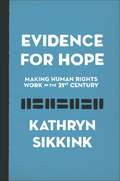
Evidence for Hope: Making Human Rights Work in the 21st Century
by Kathryn SikkinkA history of the successes of the human rights movement and a case for why human rights workEvidence for Hope makes the case that, yes, human rights work. Critics may counter that the movement is in serious jeopardy or even a questionable byproduct of Western imperialism. They point out that Guantánamo is still open, the Arab Spring protests have been crushed, and governments are cracking down on NGOs everywhere. But respected human rights expert Kathryn Sikkink draws on decades of research and fieldwork to provide a rigorous rebuttal to pessimistic doubts about human rights laws and institutions. She demonstrates that change comes slowly and as the result of struggle, but in the long term, human rights movements have been vastly effective.Attacks on the human rights movement’s credibility are based on the faulty premise that human rights ideas emerged in North America and Europe and were imposed on developing southern nations. Starting in the 1940s, Latin American leaders and activists were actually early advocates for the international protection of human rights. Sikkink shows that activists and scholars disagree about the efficacy of human rights because they use different yardsticks to measure progress. Comparing the present to the past, she shows that genocide and violence against civilians have declined over time, while access to healthcare and education has increased dramatically. Cognitive and news biases contribute to pervasive cynicism, but Sikkink’s investigation into past and current trends indicates that human rights is not in its twilight. Instead, this is a period of vibrant activism that has made impressive improvements in human well-being.Exploring the strategies that have led to real humanitarian gains since the middle of the twentieth century, Evidence for Hope looks at how these essential advances can be supported and sustained for decades to come.
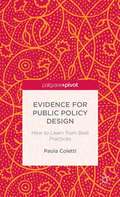
Evidence for Public Policy Design: How to Learn from Best Practice
by Paola ColettiLearning from the successes and failures of others is a necessity in the field of public sector innovation. This book develops guidelines for policymakers, practitioners and policy analysts to understand what drives policy success and to transfer innovations from a source case to a target case with a view to assisting effective policy design.
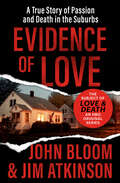
Evidence of Love: A True Story of Passion and Death in the Suburbs
by John Bloom Jim AtkinsonThe &“fascinating&” true story behind the HBO Max and Hulu series about Texas housewife Candy Montgomery and the bizarre murder that shocked a community (Los Angeles Times Book Review). Candy Montgomery and Betty Gore had a lot in common: They sang together in the Methodist church choir, their daughters were best friends, and their husbands had good jobs working for technology companies in the north Dallas suburbs known as Silicon Prairie. But beneath the placid surface of their seemingly perfect lives, both women simmered with unspoken frustrations and unanswered desires. On a hot summer day in 1980, the secret passions and jealousies that linked Candy and Betty exploded into murderous rage. What happened next is usually the stuff of fiction. But the bizarre and terrible act of violence that occurred in Betty&’s utility room that morning was all too real. Based on exclusive interviews with the Gore and Montgomery families, Edgar Award finalist Evidence of Love is the &“superbly written&” account of a gruesome tragedy and the trial that made national headlines when the defendant entered the most unexpected of pleas: not guilty by reason of self-defense (Fort Worth Star-Telegram). Adapted into the Emmy and Golden Globe Award–winning television movie A Killing in a Small Town—as well as the new limited series Candy on Hulu and Love and Death on HBO Max—this chilling tale of sin and savagery will &“fascinate true crime aficionados&” (Kirkus Reviews).
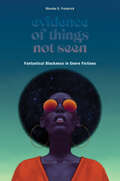
Evidence of Things Not Seen: Fantastical Blackness in Genre Fictions
by Rhonda D. FrederickEvidence of Things Not Seen: Fantastical Blackness in Genre Fictions is an interdisciplinary study of blackness in genre literature of the Americas. The “fantastical” in fantastical blackness is conceived by an unrestrained imagination because it lives, despite every attempt at annihilation. This blackness amazes because it refuses the limits of anti-blackness. As put to work in this project, fantastical blackness is an ethical praxis that centers black self-knowledge as a point of departure rather than as a reaction to threatening or diminishing dominant narratives. Mystery, romance, fantasy, mixed-genre, and science fictions’ unrestrained imaginings profoundly communicate this quality of blackness, specifically here through the work of Barbara Neely, Colson Whitehead, Nalo Hopkinson, and Colin Channer. When black writers center this expressive quality, they make fantastical blackness available to a broad audience that then uses its imaginable vocabularies to reshape extra-literary realities. Ultimately, popular genres’ imaginable possibilities offer strategies through which the made up can be made real.
Evidence of Things Seen: True Crime in an Era of Reckoning
by Sarah WeinmanFrom Sarah Weinman, the award-winning editor of Unspeakable Acts, a groundbreaking new anthology showcasing the future of the true crime genreTrue crime, as an entertainment genre, has always prioritized clear narrative arcs: victims wronged, police detectives in pursuit, suspects apprehended, justice delivered. But what stories have been ignored? In Evidence of Things Seen, fourteen of the most innovative crime writers working today cast a light on the cases that give crucial insight into our society. Wesley Lowery writes about a lynching left unsolved for decades by an indifferent police force and a family’s quest for answers. Justine van der Leun reports on the thousands of women in prison for defending themselves from abuse. May Jeong reveals how the Atlanta spa shootings tell a story of America. Edited by acclaimed writer Sarah Weinman, and with an introduction by attorney and host of the Undisclosed podcast Rabia Chaudry, this anthology pulls back the curtain on how crime itself is a by-product of America’s systemic harms and inequalities. And in doing so, it reveals how the genre of true crime can be a catalyst for social change. These works combine brilliant storytelling with incisive cultural examinations—and challenge each of us to ask what justice should look like. Evidence of Things Seen introduces the new classics of true crime.
Evidence, Policy and Wellbeing (Wellbeing in Politics and Policy)
by Ian BacheThis book analyses the role of evidence in taking wellbeing from an issue that has government attention to one that leads to significant policy change. In doing so, it draws on contributions from political science, policy theory and literature specifically on the evidence and policy relationship. The book has three main aims: to understand the role of evidence in shaping the prospects for wellbeing in public policy; to inform the barriers literature on the use of evidence in policy; and, to inform the multiple streams approach (MSA) to agenda-setting. While the book focuses on developments at UK government level, a number of the findings and arguments presented here have wider significance, both in relation to wellbeing developments elsewhere and to the theoretical literatures on agenda-setting and evidence use. The book draws on insights from interviews with policy-makers and stakeholders that were undertaken as part of the work of the Community Wellbeing Evidence Programme of the What Works Centre for Wellbeing.
Evidence-Based Counterterrorism Policy
by Leslie W. Kennedy Cynthia LumIn the past eight years, there has been a massive increase in government spending on counterterrorism intervention development and implementation. Given this increase, there are two evidence-based policy questions that are important to address: Is there evidence that any of these programs are effective - in other words, can they be shown to be linked to reducing terrorism, terrorist recruiting, or to improving the response and management of terrorist events? Do these interventions have secondary or collateral effects that may be costly, harmful, illegal, beneficial, or otherwise? As Lum and Kennedy discovered in an evaluation research on counterterrorism interventions, only a minuscule number of empirical studies of terrorism exist and there is an almost complete absence of evaluation research on counter-terrorism strategies. This is startling given the enormous increases in the development and use of counter-terrorism programs, as well as spending on counter-terrorism activity. Even more disconcerting was the nature of the evaluations we did find; some programs were shown to either have no discernible effect on terrorism or lead to increases in terrorism. The emphasis of the need for empirical research in evaluating interventions and informing policy cannot be overstated, and is the primary goal of Evidence-Based Counterterrorism Policy.
Evidence-Based Crime Prevention: Lessons From Systematic Reviews (Springer Series On Evidence-based Crime Policy Ser.)
by Brandon C. Welsh David P. Farrington Lawrence W. Sherman Doris Layton MacKenzieCrime prevention policy and practice is, on the whole, far from objective. Instead of being based on scientific evidence, the crime policy agenda is seemingly driven by political ideology, anecdotal evidence and programme trends. Evidence-Based Crime Prevention seeks to change this by comprehensively and rigorously assessing the existing scientific knowledge on the effectiveness of crime prevention programmes internationally. Reviewing more than 600 scientific evaluations of programmes intended to prevent crime in settings such as families, schools, labour markets and communities, this book grades programmes on their scientific validity using the 'scientific methods scale'. This collection, which brings together contributions from leading researchers in the field of crime prevention, will provide policy-makers, researchers and community leaders with an understandable source of information about what works, what does not work and what is promising in preventing crime.
Evidence-Based Healthcare Chaplaincy: A Research Reader
by George Fitchett Kelsey White Kathryn LyndesResearch literacy is now a requirement for Board-Certified chaplains in the US and a growing field in the UK. This reader gives an overview and introduction to the field of healthcare chaplaincy research. The 21 carefully chosen articles in this book illustrate techniques critical to chaplaincy research: case studies; qualitative research; cross-sectional and longitudinal quantitative research, and randomized clinical trials. The selected articles also address wide-ranging topics in chaplaincy research for a comprehensive overview of the field. To help readers engage with the research, each article includes a discussion guide highlighting crucial content, as well as important background information and implications for further research. This book is the perfect primary text for healthcare chaplaincy research courses, bringing together key articles from peer-reviewed journals in one student-friendly format.
Evidence-Based Interventions for Community Dwelling Older Adults
by Mph Susan M. Enguídanos PhD EditorA critical milestone in the evolution of evidence-based medicineEvidence-Based Interventions for Community Dwelling Older Adults presents an overview of significant evidence-based programs that can improve the health of seniors living in community-based settings. The book examines research conducted on a variety of health-related issues
Evidence-Based Patient Handling: Techniques and Equipment
by Pat Alexander Sue Hignett Emma Crumpton Brian Fletcher Mike Fray Sue RuszalaProviding care and treatment for patients usually requires moving and handling activities associated with high rates of back injuries. The personal and financial cost of back pain and injuries to health staff means there is an urgent need to improve practice in this area. Over the past twenty years a number of guidelines have been published, however, these have been based on professional consensus rather than evidence. Evidence-Based Patient Handling tackles the challenge of producing an evidence base to support clinical practice and covers tasks, equipment and interventions. This book questions previously held opinions about moving and handling and provides the foundation for future practice.
Evidence-Based Policing and Community Crime Prevention (Advances in Preventing and Treating Violence and Aggression)
by Emily Evans James McGuire Eddie KaneThis book addresses and reviews progress in a major innovative development within police work known as evidence-based policing. It involves a significant extension and strengthening of links between research and practice and is directed to the task of increasing police effectiveness in the field of community crime prevention. This volume provides an international perspective that synthesizes recent research results from the United States and other countries – including systematic reviews of large bodies of evidence – to illuminate several of the most challenging issues currently confronting police departments. It examines recent advances in research-based models of policing and the expanding base in outcome evaluation.Key areas of coverage include:Managing the nighttime economy.Supervising sex offenders.Tackling domestic/intimate partner violence.Addressing school violence and the formation of gangs.Reducing victim and witness retraction and disengagement.Responding to mental disorders, safeguarding vulnerable adults, and providing victim support.Leveraging public awareness campaigns.In addition, each chapter presents an overview of key issues within a designated area, synthesizes existing reviews, and examines the most recent research. The book clearly and concisely presents major concepts, theories, and research findings, thereby providing both conceptual and analytic tools alongside an integrated presentation of principal findings and messages. The volume concludes with a discussion of current directions in research, key developments in policing strategies, and identification of effective operational structures for facilitating and sustaining research-practice links.Evidence-Based Policing and Community Crime Prevention is a must-have resource for researchers, clinicians and other professionals, and graduate students in forensic psychology, criminology and criminal justice, public health, developmental psychology, psychotherapy and counseling, psychiatry, social work, educational policy and politics, health psychology, nursing, and behavioral therapy/rehabilitation.
Evidence-Based Policing: The Basics
by Jerry H. RatcliffeWhat is evidence-based policing and how is it done? This book provides an answer to both questions, offering an introduction for undergraduate students and a hands-on guide for police officers wanting to know how to put principles into practice. It serves as a gentle introduction to the terminology, ideas, and scientific methods associated with evidence-based policy, and outlines some of the existing policing applications. A couple of introductory chapters summarize evidence-based policy and its goals and origins. The core of the book eases the reader through a range of practical chapters that answer questions many people have about evidence-based practice in policing. What does good science look like? How do I find reliable research? How do I evaluate research? What is a hypothesis? How do randomized experiments work? These chapters not only provide a practical guide to reading and using existing research, but also a roadmap for readers wanting to start their own research project. The final chapters outline different ways to publish research, discuss concerns around evidence-based policing, and ask what is in the future for this emerging field. Annotated with the author’s own experiences as a police officer and researcher, and filled with simple aids, flowcharts, and figures, this practical guide is the most accessible introduction to evidence-based policing available. It is essential reading for policing students and police professionals alike. Further resources are available on the book’s website at evidencebasedpolicing.net.
Evidence-Based Policing: The Basics
by Jerry H. RatcliffeWhat is evidence-based policing and how is it done? This book provides an answer to both questions, offering an introduction for undergraduate students and a hands-on guide for police officers wanting to know how to put principles into practice. It serves as a gentle introduction to the terminology, ideas, and scientific methods associated with evidence-based policy, and outlines some of the existing policing applications. A couple of introductory chapters summarize evidence-based policy and its goals and origins. The core of the book eases the reader through a range of practical chapters that answer questions many people have about evidence-based practice in policing. What does good science look like? How do I find reliable research? How do I evaluate research? What is a hypothesis? How do randomized experiments work? These chapters not only provide a practical guide to reading and using existing research, but also a roadmap for readers wanting to start their own research project. The final chapters outline different ways to publish research, discuss concerns around evidence-based policing, and ask what is in the future for this emerging field. Annotated with the author’s own experiences as a police officer and researcher, and filled with simple aids, flowcharts, and figures, this practical guide is the most accessible introduction to evidence-based policing available. It is essential reading for policing students and police professionals alike. Further resources are available on the book’s website at evidencebasedpolicing.net.
Evidence-Based Policing: Uses, Benefits and Limitations
by Garth den HeyerThe volume aims to increase knowledge and understanding of how evidence-based policing is being adopted and implemented by police agencies in the United States and whether it is affecting the agencies' processes, strategies, community relationships and delivery of community-oriented policing services. This exploration is based on data drawn from the literature, interviews and extensive field research that resulted in the case studies presented and discussed in the book. The goal of this text will be to provide the reader with a thorough analysis of the concepts, arguments and challenges facing evidence-based policing. The history of evidence-based policing, how evidence-based practices are used in the health and social sectors, and in the United Kingdom will be examined. In addition, reasonable options for improving the use of evidence-based policing will be proposed. Overall, very practical policy implications will be outlined by a highly recognized professional who has considerable experience in policing and related research.
Evidence-Based Policy: A Realist Perspective
by Ray PawsonIn this important new book, Ray Pawson examines the recent spread of evidence-based policy making across the Western world. Few major public initiatives are mounted these days in the absence of a sustained attempt to evaluate them. Programmes are tried, tried and tried again and researched, researched and researched again. And yet it is often difficult to know which interventions, and which inquiries, will withstand the test of time. The evident solution, going by the name of evidence-based policy, is to take the longer view. Rather than relying on one-off studies, it is wiser to look to the ′weight of evidence′. Accordingly, it is now widely agreed the most useful data to support policy decisions will be culled from systematic reviews of all the existing research in particular policy domains. This is the consensual starting point for Ray Pawson′s latest foray into the world of evaluative research. But this is social science after all and harmony prevails only in the first chapter. Thereafter, Pawson presents a devastating critique of the dominant approach to systematic review - namely the ′meta-analytic′ approach as sponsored by the Cochrane and Campbell collaborations. In its place is commended an approach that he terms ′realist synthesis′. On this vision, the real purpose of systematic review is better to understand programme theory, so that policies can be properly targeted and developed to counter an ever-changing landscape of social problems. The book will be essential reading for all those who loved (or loathed) the arguments developed in Realistic Evaluation (Sage, 1997). It offers a complete blueprint for research synthesis, supported by detailed illustrations and worked examples from across the policy waterfront. It will be of especial interest to policy-makers, practitioners, researchers and students working in health, education, employment, social care, criminal justice, regeneration and welfare.
Evidence-Based Practice With Women: Toward Effective Social Work Practice With Low-Income Women (Evidence-Based Practice in Social Work)
by Bonnie L. Yegidis Martha J. MarkwardThe first book to focus on evidence-based social work practice with low-income womenThis one-of-a-kind book presents evidence-based coverage of the assessment and treatment of the most common mental health disorders among women, particularly low-income women. For each disorder— depression, post-traumatic stress disorder and trauma (including sexual abuse), generalized anxiety disorder, substance use disorder, and borderline personality disorder—the authors include assessment instruments and detailed case examples that illustrate the assessment and treatment recommendations.
Evidence-Based Practice in Action: Bridging Clinical Science and Intervention
by Sona DimidjianA growing number of empirically supported treatments are available to mental health practitioners, yet evidence-based practice requires knowledge and skills that are often overlooked in clinical training. This authoritative reference and text grounds the reader in the concepts, rationale, and methods of evidence-based practice. Clinicians and students are guided to consult and evaluate the research literature, use data to inform clinical decision making, consider the role of culture and context, craft sound case formulations, monitor progress and outcomes, and continuously develop their expertise. Of particular utility, the book includes rich, chapter-length case studies. Leading proponents of cognitive-behavioral therapy, dialectical behavior therapy, behavioral activation, and other approaches make explicit the ways they draw on evidence throughout the process of assessment and treatment.
Evidence-Based Practice in Clinical Social Work
by James W. Drisko Melissa D GradyEvidence-Based Practice in Clinical Social Work introduces the key ideas of evidence-based clinical social work practice and their thoughtful application. It intends to inform practitioners and to address the challenges and needs faced in real world practice. This book lays out the many strengths of the EBP model, but also offers perspectives on its limitations and challenges. An appreciative but critical perspective is offered throughout. Practical issues (agency supports, access to research resources, help in appraising research) are addressed - and some practical solutions offered. Ethical issues in assessment/diagnosis, working with diverse families to make treatment decisions, and delivering complex treatments requiring specific skill sets are also included.