- Table View
- List View
Real and Imagined Women: Gender, Culture and Postcolonialism
by Rajeswari Sunder RajanAn essential addition to the postcolonial debate which offers a challenging mode of `reading resistance' which destroys the stereotyped and sensationalised humanist image of the `third world woman' as victim.
Real-World Crime Scene Investigation: A Step-by-Step Procedure Manual
by Gabriele SubochReal-World Crime Scene Investigation: A Step-by-Step Procedure Manual is designed as a field guide providing instruction on how to document a crime scene, including sketching, mapping, searching, collecting, and preserving physical evidence. It also addresses how to document a crime scene using photography and videography. It introduces modern fore
Real-life Mythical Creatures and Their Stories of Survival (Real-life Monsters)
by Anita GaneriImmerse yourself in the fascinating stories of ten real-life mythical creatures, exploring the legends that surround them, their discoveries and seeing how they survive today.From blood-sucking vampires and fiery phoenixes, to howling werewolves and shaggy-haired yetis, mysterious, and often mischievous, creatures appear in myths and legends from around the world. For centuries, they have puzzled, fascinated and frightened people, sometimes being used to teach a lesson or to warn of danger. But have these beasts ever really existed, and, most importantly, are any of them around today?This book brings together ten real-life mythical creatures, with fascinating facts and folklore. There are tales of how they were discovered, where they live, and about their adaptations for surviving in the wild.It's time to set off on the mythical monster hunt of a lifetime.ENTER IF YOU DARE!This high-interest approach to the natural world shows the diversity of nature, evolution and adaptation and can be used to support the science curriculum study of living things at key stage two.Full-colour photographs combined with illustrations make this a beautiful and fascinating introduction to real-life mythical creatures around the world.
RealWorld Evaluation: Working Under Budget, Time, Data, and Political Constraints
by J. John Bamberger Jim Rugh Linda S. MabryThis book addresses the challenges of conducting program evaluations in real-world contexts where evaluators and the agencies face budget and time constraints and where critical data is missing. The book is organized around a seven-step model developed by the authors, which has been tested and refined in workshops. Vignettes and case studies—representing evaluations from a variety of geographic regions and sectors—demonstrate adaptive possibilities for small projects with budgets of a few thousand dollars to large-scale, long-term evaluations. The text incorporates quantitative, qualitative, and mixed-method designs and this Second Edition reflects important developments in the field over the last five years.
RealWorld Evaluation: Working Under Budget, Time, Data, and Political Constraints
by Linda S. Mabry J. Michael BambergerRealWorld Evaluation: Working Under Budget, Time, Data, and Political Constraints addresses the challenges of conducting program evaluations in real-world contexts where evaluators and their clients face budget and time constraints. The book is organized around the authors’ seven-step model that has been tested in workshops and practice environments to help the evaluation implementers and managers make the best choices when faced with real world constraints. The Third Edition includes a new chapter on gender equality and women’s empowerment and discussion of digital technology and data science.
RealWorld Evaluation: Working Under Budget, Time, Data, and Political Constraints
by Linda S. Mabry J. Michael BambergerRealWorld Evaluation: Working Under Budget, Time, Data, and Political Constraints addresses the challenges of conducting program evaluations in real-world contexts where evaluators and their clients face budget and time constraints. The book is organized around the authors’ seven-step model that has been tested in workshops and practice environments to help the evaluation implementers and managers make the best choices when faced with real world constraints. The Third Edition includes a new chapter on gender equality and women’s empowerment and discussion of digital technology and data science.
Realisation-from Seeing to Understanding
by Julian SpaldingOur world view has changed from a flat earth under the dome of heaven to a planet spinning in the universe. We perceived the world as a body, like ours, then as a tree, a pyramid, an altar, and finally as a veil which became a window through which we peered only to discover ourselves on a sphere, a bubble which might burst at any moment. Our changing views are interpreted through iconic images of the remote and more recent past: the Venus of Willendorf, the Pyramids, Stonehenge, the Taj Mahal, the Scream, Sydney Opera House, and the Guggenheim, Bilbao.
Realising Socio-Economic Rights of Refugees and Asylum Seekers in Africa: Our Lives Matter (Politics of Citizenship and Migration)
by Ebenezer Durojaye Gladys Mirugi-Mukundi Robert Doya Nanima Abiola Idowu-OjoThis book examines the socio-economic rights challenges of refugees and asylum seekers in Africa. It seeks to fill a major gap in the literature by providing a nuanced discussion of the barriers to the realisation of the socio-economic rights of refugees and asylum seekers in Africa. It equally aims to provide some concrete recommendations to African governments towards the realisation of the socio-economic rights of refugees and asylum seekers. With the aid of lessons from selected African countries, this book highlights the gaps, challenges and good practices regarding the realisation of the socio-economic rights of refugees and asylum seekers in the region. The book will be useful to researchers, students, academicians, policymakers, and international organisations or institutions interested in advancing the rights of refugees and asylum seekers.
Realising the 'Triple Dividend of Resilience'
by Swenja Surminski Thomas TannerWhy aren't we investing more in disaster resilience, despite the rising costs of disaster events? This book argues that decision-makers in governments, businesses, households, and development agencies tend to focus on avoiding losses from disasters, and perceive the return on investment as uncertain - only realised if a somewhat unlikely disaster event actually happens. This book develops a new business case for investment based on the multiple dividends of resilience. This looks beyond only avoided losses (the first dividend) to the wider benefits gained independently of whether or not the disaster event occurs. These include unleashing entrepreneurial activities and productive investments by lowering the looming threat of losses from disasters and enabling businesses, farmers and homeowners to take positive risks (the second dividend); and co-benefits of resilience measures beyond just disaster risk (the third dividend), such as flood embankments in Bangladesh that double as roads, or wetlands in Colombo that reduce urban heat extremes.

Realism
by Linda NochlinTraces the development of realism in nineteenth-century art, focusing on the cultural and political changes that influenced it
Realism and Complexity in Social Science (Complexity in Social Science)
by Malcolm WilliamsRealism and Complexity in Social Science is an argument for a new approach to investigating the social world, that of complex realism. Complex realism brings together a number of strands of thought, in scientific realism, complexity science, probability theory and social research methodology. It proposes that the reality of the social world is that it is probabilistic, yet there exists enough invariance to make the discovery and explanation of social objects and causal mechanisms possible. This forms the basis for the development of a complex realist foundation for social research, that utilises a number of new and novel approaches to investigation, alongside the more traditional corpus of quantitative and qualitative methods. Research examples are drawn from research in sociology, epidemiology, criminology, social policy and human geography. The book assumes no prior knowledge of realism, probability or complexity and in the early chapters, the reader is introduced to these concepts and the arguments against them. Although the book is grounded in philosophical reasoning, this is in a direct and accessible style that will appeal both to social researchers with a methodological interest and philosophers with an interest in social investigation.
Realism and Interdependence in Singapore's Foreign Policy (Politics in Asia)
by Narayanan GanesanSingapore’s existence and success derive in part from its achievements in the domestic political arena and in part from the skilful management of a well-defined foreign policy with clearly identifiable goals and issues. A visible core of realist self-reliance is layered with the demands of a competitive trading state that requires a liberal international trading regime. Hence, both competitive and cooperative philosophies support Singapore’s foreign policy. This text charts the philosophical underpinning of Singapore’s foreign policy output and the institutions responsible for it and examines the importance of economic and defence diplomacy that are central to Singapore’s foreign policy output. It gives particular attention to the two most important regional bilateral relationships -- with Indonesia and Malaysia -- and how relations with its adjacent neighbours have influenced Singapore’s foreign policy. Combining first-hand research with excellent analysis, this volume provides a much-needed report on the survival of a small state in the globalizing world.
Realism and Psychological Science
by David J. MareeThe book provides an argument why realism is a viable metatheoretical framework for psychological science. By looking at some variations of realism such as scientific realism, critical realism, situational realism and Ferraris’ new realism, a realist view of science is outlined that can feature as a metatheory for psychological science. Realism is a necessary correction for the mythical image of science responsible for and maintained by a number of dichotomies and polarities in psychology. Thus, the quantitative-qualitative dichotomy, scientist-practitioner polarity and positivist-constructionist opposition feed off and maintains a mythic image of science on levels of practice, methods and metatheory. Realism makes a clear distinction between ontology and epistemic access to reality, the latter which easily fits with softer versions of constructionism, and the former which grounds science in resistance and possibility, loosely translated as criticism. By taking science as a critical activity an issue such as the quantitative imperative looses its defining force as a hallmark of science - it provides epistemic access to certain parts of reality. In addition, essentially critical activities characteristic of various qualitative approaches may be welcomed as proper science. Academics, professionals and researchers in psychology would find value in situating their scholarly work in a realist metatheory avoiding the pitfalls of traditional methodologies and theories.
Realism and Racism: Concepts of Race in Sociological Research (Critical Realism Ser.)
by Bob CarterThere are continuing difficulties within social science surrounding concepts of race. This book suggests that these difficulties stem from the uncertain ontological and epistemological status of ideas about race, itself a consequence of the recognition that concepts of race have all but lost their relevance as sociologically significant descriptions. This book surveys ways in which social scientists have attempted to come to terms with this situation, before developing an alternative approach based on recent work by realist authors. This approach offers a radical revision of orthodox debates about race concepts, about the possibility of a social science and about the nature of empirical research. This illustrated through two policy examples: an account of post war migration to the UK, and debates about trans-racial adoption in the UK and the USA.
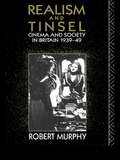
Realism and Tinsel: Cinema and Society in Britain 1939-48 (Cinema and Society)
by Robert MurphyFirst published in 1992. Routledge is an imprint of Taylor & Francis, an informa company.
Realism for Social Sciences: A Translational Approach to Methodology (Translational Systems Sciences #36)
by Yoshiyuki Takeuchi Ken Urai Masaaki KatsuragiThis book discusses the growing interest in realism in social sciences of the twenty-first century. The first part of this book provides recent discussions on realism in philosophy. The second part describes specific problems that have returned to realism in various fields of the social sciences, such as economics, cultural anthropology, management science, and statistics. This book clarifies what kinds of movements are taking place and consequently the direction in which the social sciences are heading in the future. Readers would also find that there is great diversity in the way realism and reality are perceived and understood, depending on the objectives and circumstances of each field of social science. This suggests that rather than having a unified view (stance) of realism and reality, it may be more meaningful to value the differences, diversity, and range itself. Therefore, this book does not present a unified view of realism, reality, and actuality. Although the definitions of realism and reality may differ from chapter to chapter, this represents a corner of the current state of the social sciences. This book is unique in that it examines how the issues of realism and reality are viewed, understood, and dealt with in the various fields of social science, instead of examining them by philosophers and philosophers of science. This would clarify how philosophical discussions have been translated into the various fields of social science.
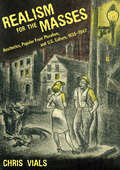
Realism for the Masses: Aesthetics, Popular Front Pluralism, and U.S. Culture, 1935–1947
by Chris VialsRealism for the Masses is an exploration of how the concept of realism entered mass culture, and from there, how it tried to remake “America.” The literary and artistic creations of American realism are generally associated with the late nineteenth century. But this book argues that the aesthetic actually saturated American culture in the 1930s and 1940s and that the Left social movements of the period were in no small part responsible. The book examines the prose of Carlos Bulosan and H. T. Tsiang; the photo essays of Margaret Bourke-White in Life magazine; the bestsellers of Erskine Caldwell and Margaret Mitchell; the boxing narratives of Clifford Odets, Richard Wright, Nelson Algren; and the Hollywood boxing film, radio soap operas, and the domestic dramas of Lillian Hellman and Shirley Graham, and more. These writers and artists infused realist aesthetics into American mass culture to an unprecedented degree and also built on a tradition of realism in order to inject influential definitions of “the people” into American popular entertainment. Central to this book is the relationship between these mass cultural realisms and emergent notions of pluralism. Significantly, Vials identifies three nascent pluralisms of the 1930s and 1940s: the New Deal pluralism of “We're the People” in The Grapes of Wrath; the racially inclusive pluralism of Vice President Henry Wallace's “The People's Century”; and the proto-Cold War pluralism of Henry Luce's “The American Century.”
Realism, Idealism and International Politics: A Reinterpretation
by Martin GriffithsFirst published in 1992. Martin Griffiths' book provides a reinterpretation of the terms 'realism' and 'idealism' in international relations, and a thorough critical examination of three key figures in international theory: Hane Morgenthau, Kenneth Waltz and Hedley Bull. This is an important book proving a compelling basis for conceiving international politics as a 'rule-governed' arena among states. It will be of great interest to scholars and students of international relations.
Realism, Myth, and the Vernacular in Pasolini's Film and Philosophy: Beyond the Middle-Class Matrix
by Max RyynänenPier Paolo Pasolini’s lifework has been studied through the lens of queer studies, film studies, poetry, and many other angles, but there are themes that one could still study. This book aims to bring forth a new understanding of Pasolini as someone who worked in various arts, and through appropriating one art with. Max Ryynänen shows Pasolini’s importance for not just film and film theory, but more broadly visual studies, art research and even cultural philosophy – where Pasolini can be seen to be a real pioneer in discussing unprivileged margins in the society. Ryynänen reads Pasolini not just as a semiotician of film, but also as a cultural philosopher, and argues for that interpretation.
Realist Criminology
by Roger MatthewsThis book challenges contemporary criminological thinking, providing a thorough critique of mainstream criminology, including both liberal criminology and administrative criminology. It sets a new agenda for theoretical and practical engagement, and for creating a more effective and just criminal justice system.
Realist Ecstasy: Religion, Race, and Performance in American Literature (Performance and American Cultures #2)
by Lindsay V. RecksonHonorable Mention, Barnard Hewitt Award from the American Society for Theater ResearchExplores the intersection and history of American literary realism and the performance of spiritual and racial embodiment. Recovering a series of ecstatic performances in late nineteenth- and early twentieth-century American realism, Realist Ecstasy travels from camp meetings to Native American ghost dances to storefront church revivals to explore realism’s relationship to spiritual experience. In her approach to realism as both an unruly archive of performance and a wide-ranging repertoire of media practices—including literature, photography, audio recording, and early film—Lindsay V. Reckson argues that the real was repetitively enacted and reenacted through bodily practice. Realist Ecstasy demonstrates how the realist imagining of possessed bodies helped construct and naturalize racial difference, while excavating the complex, shifting, and dynamic possibilities embedded in ecstatic performance: its production of new and immanent forms of being beside. Across her readings of Stephen Crane, James Weldon Johnson, and Nella Larsen, among others, Reckson triangulates secularism, realism, and racial formation in the post-Reconstruction moment. Realist Ecstasy shows how post-Reconstruction realist texts mobilized gestures—especially the gestures associated with religious ecstasy—to racialize secularism itself. Reckson offers us a distinctly new vision of American realism as a performative practice, a sustained account of how performance lives in and through literary archives, and a rich sense of how closely secularization and racialization were linked in Jim Crow America.
Realist Evaluation for Crime Science: Essays in Honour of Nick Tilley (Crime Science Series)
by Graham Farrell Aiden SidebottomThis collection of essays, published to mark the 20th anniversary of Realistic Evaluation, celebrates the work of Professor Nick Tilley and his significant influence on the fields of policing, crime reduction and evaluation. With contributions from colleagues, co-authors and former students, many of whom are leading scholars in their own right, the thirteen essays which make up this volume contain both personal reflections and analysis of the prominent topics in Professor Tilley’s forty years of scholarship.
Realist Evaluation in Practice: Health and Social Work
by Mansoor A Kazi'The strengths of this book are the first two chapters outlining the issues around realist evaluation and the final chapter, as well as the use throughout the book of real-life examples... in conclusion this is a timely introductory text on the methods and methodology of realist evaluation' - Critical Public Health Realist evaluation is an exciting new way to investigate what works, for whom and in what contexts and here for the first time, Mansoor A F Kazi shows how it applies to today's practice in social work, health and other human services. To show how realist evaluation has the potential to change practice, the author provides in-depth examples of evaluation in adult rehabilitation, drug-using communities, users of family centres and an NSPCC project that provides services for children who sexually harm other children. Within these instances, realist evaluation procedures were integrated into the practice and decisions regarding the content and the targeting of services were developed effectively. Written in an engaging style, this book will be of value to social workers and all those engaged in service delivery or research across the spectrum of health and social care.
Realist Evaluation: Principles and Practice
by Emma Williams Ana ManzanoRealist Evaluation: Principles and Practice offers a comprehensive exploration of contemporary realist evaluation, showcasing how skilled practitioners navigate diverse fieldwork contexts.Authored by experts spanning academia and evaluation backgrounds across five continents in fields including climate change, criminology, health, and international development, the book provides a rich tapestry of perspectives. Covering participatory approaches, digital and visual data collection, interpreter-mediated interviews, and innovative methods like refuse data analysis, the authors delve into contemporary social research methodologies while addressing issues such as power, insider/outsider research, the nature of evidence, critical and scientific realism philosophies of science, and confirmation bias in qualitative research. Practical advice is provided in areas such as developing a topic guide, combining a realist review with an evaluation, and managing large, multi-site cross-national projects. This collection underscores the creative nature of the realist imagination, highlighting ongoing innovations by scholars and evaluators.With contributions from an outstanding group of internationally renowned experts in realist evaluation including Nick Tilley, a key figure in the development of realist evaluation alongside Ray Pawson, this is the ideal text for students, researchers and professionals including policy makers, professional evaluators, and those at organisations such as thinktanks and NGOs, who require an accessible guide on how to use realist evaluation methods.Chapters: Chapter 3 of this book is freely available as a downloadable Open Access PDF at http://www.taylorfrancis.com under a Creative Commons [Attribution-Non Commercial-No Derivatives (CC-BY-NC-ND) 4.0 license
Realist Inquiry in Social Science
by Brian Douglas Haig Colin W. EversRealist Inquiry in Social Science is an invaluable guide to conducting realist research. Written by highly regarded experts in the field, the first part of the book sets out the fundamentals necessary for rigorous realist research, while the second part deals with a number of its most important applications, discussing it in the context of case studies, action research and grounded theory amongst other approaches. Grounded in philosophical methodology, this book goes beyond understanding knowledge justification only as empirical validity, but instead emphasises the importance of theoretical criteria for all good research. The authors consider both quantitative and qualitative research methods, and approach methodology from an interdisciplinary viewpoint. Using abductive reasoning as the starting point for an insightful journey into realist inquiry, this book demonstrates that scientific realism continues to be of major relevance to the social sciences.