- Table View
- List View
Realist Inquiry in Social Science
by Brian Douglas Haig Colin EversRealist Inquiry in Social Science is an invaluable guide to conducting realist research. Written by highly regarded experts in the field, the first part of the book sets out the fundamentals necessary for rigorous realist research, while the second part deals with a number of its most important applications, discussing it in the context of case studies, action research and grounded theory amongst other approaches. Grounded in philosophical methodology, this book goes beyond understanding knowledge justification only as empirical validity, but instead emphasises the importance of theoretical criteria for all good research. The authors consider both quantitative and qualitative research methods, and approach methodology from an interdisciplinary viewpoint. Using abductive reasoning as the starting point for an insightful journey into realist inquiry, this book demonstrates that scientific realism continues to be of major relevance to the social sciences.
Realist Paradigm of International Relations: Power, Systems and Game Theories
by Amartya MukhopadhyayThis book explores realist theories—also called power politics approaches, formulations of systems theories, and game theory in International Relations (IR). The first section of the book focuses on theories of Early Classical Realism—Thucydides, Machiavelli, and Hobbes, and two Asian exponents—Kautilya and Han Fei Tzu. It covers the rise and fall of different schools of imperial geopolitics including those developed during the Cold-War and postmodern periods. It also discusses theories proposed by three stalwarts of Neoclassical Realism— Niebuhr, Carr, and Morgenthau; the Neorealism of Waltz; Strategic Realism of Schelling; and Offensive Realism of Mearsheimer. The book also examines theoretic formulations of Kaplan, Modelski, Rosecrance, McClelland, Holsti, and Singer, as well as game theory and its relevance and application in international relations. It explores diverse variants of theories of power in international relations through a critical readings of texts and IR literature. This book will be of interest to researchers and students of political science, international relations, history and law.
Realist Responses to Post-Human Society: Ex Machina (The Future of the Human)
by Jamie Morgan Ismael Al-AmoudiThis volume is the first of a trilogy which investigates, from a broadly realist perspective, the place, and challenges, of the human in contemporary social orders. The authors, all members of the Centre for Social Ontology, ask what is specific about humanity’s nature and worth, and what are their main challenges in contemporary societies? Examining the ways in which recent advances in technology threaten to blur and displace the boundaries constitutive of our shared humanity, Realist Responses to Post-Human Society: Ex Machina explores the philosophical and ethical questions raised by these developments, and discusses the dangers posed by the combination of transhumanism with post-humanist social theories and antihumanist practices, institutions and ideologies.
Realistic Evaluation
by Ray Pawson Nick TilleyRealistic Evaluation shows how program evaluation needs to be, and can be bettered. It presents a profound yet highly readable critique of current evaluation practice, and goes on to introduce a `manifesto′ and `handbook′ for a fresh approach. The main body of this book is devoted to the articulation of a new evaluation paradigm, which promises greater validity and utility from the findings of evaluation studies. The authors call this new approach `realistic evaluation′. The name reflects the paradigm′s foundation in scientific realist philosophy, its commitment to the idea that programmes deal with real problems rather than mere social constructions, and its primary intention, which is to inform realistic developments in policy making that benefit programme participants and the public. Ray Pawson and Nicholas Tilley argue with passion that scientific evaluation requires a careful blend of theory and method, quality and quantity, ambition and realism. The book offers a complete blueprint for evaluation activities, running from design to data collection and analysis to the cumulation of findings across programmes and onto the realization of research into policy. The argument is developed using practical examples throughout and is grounded in the major fields of programme evaluation. This book will be essential reading for all those involved in the evaluation process especially those researchers, students and practitioners in the core disciplines of sociology, social policy, criminology, health and education. `This book is a must for those engaged in the field, providing a fully illustrated text on evaluation with numerous examples from the criminal justice system. Unusually, it offers something for the academic, practitioner and student alike. I found Pawson and Tilley′s latest work on evaluation an enjoyable and informative read. For myself their "realistic evaluation" clarified and formalised a jumbled set of ideas I had already been developing. Although not everyone will agree with the methodology proposed by the authors, this book is a valuable read as it will cause most of us at least to review our methodological stance′ - International Journal of Police Science and Management `This is an engaging book with a strong sense of voice and communicative task. The voice is sometimes strident, but always clear. Its communicative qualities are evident equally in its structure: lots of signposting for the reader within and across chapters′ - Language Teaching Research `This provocative, elegant and highly insightful book focuses on the effective incorporation of actual practice into the formulation of evaluation methodology. What a pleasure to read sentences like: "The research act involves "learning" a stakeholder′s theories, formalizing them, and "teaching" them back to that informant who is then in a position to comment upon, clarify and further refine the key ideas". Pawson and Tilley have given us a wise, witty and persuasive account of how real practitioner experience might be encouraged to intrude on (and modify) researchers′ concepts about program processes and outcomes. This holds important promise for achieving something that is devoutly to be wished: closer interaction among at least some researchers and some policy makers′ - Eleanor Chelimsky, Past-President of the American Evaluation Association `This is a sustained methodological argument by two wordly-wise social scientists. Unashamedly intellectual, theoretically ambitious yet with a clear but bounded conception of evaluation. It is articulate, occasionally eloquent and always iconoclastic, whilst eschewing "paradigm wars". The Pawson and Tilley "realist" call to arms threatens to take no prisoners among experimentalists, constructivists or pluralists. It is the kind of book that clarifies your thoughts, even when you disagree with everything they say′ - Elliot Stern, The Tavistock Institu
Realities of Critical Pedagogy: A Microethnography of a Parisian Autonomous High School (Anthropological Studies of Education)
by Mehdi GaliereThis book examines how the Lycée autogéré de Paris, an experimental high school established in 1982 which claims to implement critical and democratic pedagogical practices, contributes to the development of counter-hegemonic educational and social practices. The author presents and analyses significant discursive data on the school’s pedagogical practice, focusing specifically on triangulation, from general assemblies to official texts, pedagogic projects and everyday interactions inside and outside the institution. He then argues that the discourses of the self-managed high school tend to be critical of the French state’s neoliberal discourse on education while favouring the development of practices of solidarity within the local and broader context of the institution. The book will be of interest to students and scholars in the fields of sociology of education, sociolinguistics and education for social justice.
Reality Bites Back: The Troubling Truth About Guilty Pleasure TV
by Jennifer L. PoznerNearly every night on every major network, "unscripted" (but carefully crafted) "reality" TV shows routinely glorify retrograde stereotypes that most people would assume got left behind 35 years ago. In Reality Bites Back, media critic Jennifer L. Pozner aims a critical, analytical lens at a trend most people dismiss as harmless fluff. She deconstructs reality TV's twisted fairytales to demonstrate that far from being simple "guilty pleasures," these programs are actually guilty of fomenting gender-war ideology and significantly affecting the intellectual and political development of this generation's young viewers. She lays out the cultural biases promoted by reality TV about gender, race, class, sexuality, and consumerism, and explores how those biases shape and reflect our cultural perceptions of who we are, what we're valued for, and what we should view as "our place" in society. Smart and informative, Reality Bites Back arms readers with the tools they need to understand and challenge the stereotypes reality TV reinforces and, ultimately, to demand accountability from the corporations responsible for this contemporary cultural attack on three decades of feminist progress.
Reality Gendervision: Sexuality and Gender on Transatlantic Reality Television
by Brenda R. WeberThis essay collection focuses on the gendered dimensions of reality television in both the United States and Great Britain. Through close readings of a wide range of reality programming, from Finding Sarah and Sister Wives to Ghost Adventures and Deadliest Warrior, the contributors think through questions of femininity and masculinity, as they relate to the intersections of gender, race, class, and sexuality. They connect the genre's combination of real people and surreal experiences, of authenticity and artifice, to the production of identity and norms of citizenship, the commodification of selfhood, and the naturalization of regimes of power. Whether assessing the Kardashian family brand, portrayals of hoarders, or big-family programs such as 19 Kids and Counting, the contributors analyze reality television as a relevant site for the production and performance of gender. In the process, they illuminate the larger neoliberal and postfeminist contexts in which reality TV is produced, promoted, watched, and experienced.Contributors. David Greven, Dana Heller, Su Holmes, Deborah Jermyn, Misha Kavka, Amanda Ann Klein, Susan Lepselter, Diane Negra, Laurie Ouellette, Gareth Palmer, Kirsten Pike, Maria Pramaggiore, Kimberly Springer, Rebecca Stephens, Lindsay Steenberg, Brenda R. Weber
Reality Isn't What It Used to Be: Theatrical Politics, Ready-to-Wear Religion, Global Myths, Primitive Chic, and Other Wonders of the Postmodern World
by Walter Truet AndersonAnderson reveals the reality of postmodernism in politics, popular culture, religion, literary criticism, art, and philosophy -- making sense of everything from deconstructionism to punk.
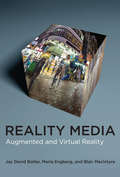
Reality Media: Augmented and Virtual Reality
by Jay David Bolter Maria Engberg Blair MacIntyreHow augmented reality and virtual reality are taking their places in contemporary media culture alongside film and television.TThis book positions augmented reality (AR) and virtual reality (VR) firmly in contemporary media culture. The authors view AR and VR not as the latest hyped technologies but as media—the latest in a series of what they term &“reality media,&” taking their places alongside film and television. Reality media inserts a layer of media between us and our perception of the world; AR and VR do not replace reality but refashion a reality for us. Each reality medium mediates and remediates; each offers a new representation that we implicitly compare to our experience of the world in itself but also through other media. The authors show that as forms of reality media emerge, they not only chart a future path for media culture, but also redefine media past. With AR and VR in mind, then, we can recognize their precursors in eighteenth-century panoramas and the Broadway lights of the 1930s. A digital version of Reality Media, available through the book&’s website, invites readers to visit a series of virtual rooms featuring interactivity, 3-D models, videos, images, and texts that explore the themes of the book.
Reality Show: Inside the Last Great Television News War
by Howard KurtzDan Rather, Tom Brokaw, Peter Jennings: They were on a first-name basis with the country for a generation, leading viewers through moments of triumph and tragedy. But now that a new generation has succeeded them, the once-glittering job of network anchor seems unmistakably tarnished. In an age of instantaneous Internet news, cable echo chambers and iPod downloads, who really needs the evening news? And, by extension, who needs Katie Couric, Brian Williams, and Charlie Gibson? But the anchors still have a megaphone capable of cutting through the media static. Their coverage of Iraq helped turn the country against that bloody war, and they are now playing a leading role in chronicling the collapse of George Bush's presidency and the 2008 race to succeed him. Yet, even as the anchors fight for ratings supremacy, the mega-corporations they work for have handed them a bigger challenge: saving an American institution. In this freewheeling, intimate account of life atop the media pyramid, award-winning bestselling author Howard Kurtz takes us inside the newsrooms and executive suites of CBS, NBC, and ABC, capturing the deadline judgments, image-making, jealousies, and gossip of this high-pressure business. Whether it is Couric trying to regain her morning magic while coping with tabloid stories about her boyfriends, Williams reporting from New Orleans and Baghdad while worrying about his ailing father, or Gibson weighing whether to follow his wife into retirement while grappling with having to report the explicit details of sex scandals, Kurtz brings to life the daily battles that define their lives. The narrative reflects an extraordinary degree of access to such corporate chieftains as Jeff Zucker and Les Moonves, star correspondents, and the anchors themselves. Their goal: create an on-screen persona that people will tune in to and trust. Yet they are faced with a graying, shrinking audience as younger viewers flock to Jon Stewart, whose influence on the real newscasts is palpable. Here is the untold story of what these journalistic celebrities think of their bosses, cable competitors, bloggers, and each other.

Reality TV
by Laurie Ouellette Susan MurraySurvivor. The Bachelor. Extreme Makeover. Big Brother. Joe Millionaire. American Idol. The Osbournes. It is virtually impossible to turn on a television without coming across some sort of reality programming. Yet, while this genre has rapidly moved from the fringes of television culture to its lucrative core, critical attention has not kept pace. Beginning by unearthing its historical roots in early reality shows like Candid Camera and wending its way through An American Family, Cops, and The Real World to the most recent crop of reality programs, Reality TV is the first book to address the economic, visual, cultural, and audience dimensions of reality television. The essays provide a complex and comprehensive picture of how and why this genre emerged, what it means, how it differs from earlier television programming, and how it engages societies, industries, and individuals. Topics range from the construction of televisual "reality" to the changing face of criminal violence on TV, to issues of surveillance, taste, and social control. By spanning reality television's origins in the late 1940s to its current overwhelming popularity, Reality TV demonstrates both the tenacity of the format and its enduring ability to speak to our changing political and social desires and anxieties. Contributors include: Nick Couldry, Mary Beth Haralovich, John Hartley, Chuck Kleinhans, Derek Kompare, Jon Kraszewski, Kathleen LeBesco, Justin Lewis, Ted Magder, Jennifer Maher, Anna McCarthy, Rick Morris, Chad Raphael, Elayne Rapping, Jeffrey Sconce, Michael W. Trosset, Pamela Wilson.
Reality TV (Routledge Television Guidebooks)
by Jon KraszewskiFrom early first-wave programs such as Candid Camera, An American Family, and The Real World to the shows on our television screens and portable devices today, reality television consistently takes us to cities—such as New York, Los Angeles, and Boston—to imagine the place of urbanity in American culture and society. Jon Kraszewski offers the first extended account of this phenomenon, as he makes the politics of urban space the center of his history and theory of reality television. Kraszewski situates reality television in a larger economic transformation that started in the 1980s when America went from an industrial economy, when cities were home to all classes, to its post-industrial economy as cities became key points in a web of global financing, expelling all economic classes except the elite and the poor. Reality television in the industrial era reworked social relationships based on class, race, and gender for liberatory purposes, which resulted in an egalitarian ethos in the genre. However, reality television of the post-industrial era attempts to convince viewers that cities still serve their interests, even though most viewers find city life today economically untenable. Each chapter uses a key theoretical concept from spatial theory—such as power geometries, diasporic nostalgia, orientalism, the imagination of social expulsions, and the relationship between the country and the city—to illuminate the way reality television engages this larger transformation of urban space in America.
Reality TV and Queer Identities: Sexuality, Authenticity, Celebrity
by Michael LovelockThis book examines queer visibility in reality television, which is arguably the most prolific space of gay, lesbian, transgender and otherwise queer media representation. It explores almost two decades of reality programming, from Big Brother to I Am Cait, American Idol to RuPaul’s Drag Race, arguing that the specific conventions of reality TV—its intimacy and emotion, its investments in celebrity and the ideal of authenticity—have inextricably shaped the ways in which queer people have become visible in reality shows. By challenging popular judgements on reality shows as damaging spaces of queer representation, this book argues that reality TV has pioneered a unique form of queer-inclusive broadcasting, where a desire for authenticity, rather than being heterosexual, is the norm. Across all chapters, this book investigates how reality TV’s celebration of ‘compulsory authenticity’ has circulated ‘acceptable’ and ‘unacceptable’ ways of being queer, demonstrating how possibilities for queer visibility are shaped by broader anxieties and around selfhood, identity and the real in contemporary cultural life.
Reality TV: Factual Entertainment And Television Audiences (Key Ideas in Media & Cultural Studies)
by Annette HillReality TV is popular entertainment. And yet a common way to start a conversation about it is ‘I wouldn’t want anyone to know this but…’ Why do people love and love to hate reality TV? This book explores reality TV in all its forms - from competitive talent shows to reality soaps - examining a range of programmes from the mundane to those that revel in the spectacle of excess. Annette Hill’s research draws on interviews with television producers on the market of reality TV and audience research with over fifteen thousand participants during a fifteen year period. Key themes in the book include the phenomenon of reality TV as a new kind of inter-generic space; the rise of reality entertainment formats and producer intervention; audiences, fans and anti-fans; the spectacle of reality and sports entertainment; and the ways real people and celebrities perform themselves in cross-media content. Reality TV explores how this form of popular entertainment invites audiences to riff on reality, to debate and reject reality claims, making it ideal for students of media and cultural studies seeking a broader understanding of how media connects with trends in society and culture.
Reality TV: Factual Entertainment and Television Audiences (Key Ideas In Media And Cultural Studies)
by Annette HillReality TV restores a crucial, and often absent, element to the critical debate about reality television: the voices of people who watch reality programmes. From Animal Hospital to Big Brother, Annette Hill argues that much can be learned from listening to audience discussion about this popular and rapidly changing television genre. Viewers' responses to reality TV can provide invaluable information to enhance our understanding of both the reality genre and contemporary television audiences. Drawing on quantitative and qualitative audience research to understand how viewers categorise the reality genre, and how they judge the performance of ordinary people and the representation of authenticity within different types of reality programmes. * Do audiences think reality TV is real? * Can people learn from watching reality TV? * How critical are viewers of reality TV? Reality TV argues that audiences are engaged in a critical examination of the development of popular factual television. The book examines how audiences can learn from watching reality programmes, and how viewers think and talk about the ethics of reality TV.
Reality TV: Realism and Revelation
by Biressi Anita Heather NunnReality television has little to do with reality and everything to do with television form and content. Reality TV: Realism and Revelation takes the reality television phenomenon to be a significant movement within documentary and factual programming. This book analyses new and hybrid genres including observational documentaries, talk shows, game shows, docu-soaps, dramatic reconstructions, law and order programming and 24/7 formats such as Big Brother and Survivor. These programmes are both popular with audiences and heavily debated in the media; they are at the centre of heated discussions about tabloidisation, media ethics, voyeurism and the representation of the real. Through detailed case studies this book breaks new ground by linking together two major themes: the production of realism and its relationship to revelation. It addresses 'truth telling', confession and the production of knowledges about the self and its place in the world.
Reality TV: Realism and Revelation (Television Studies)
by Heather Nunn Anita BiressiThis book analyses new and hybrid genres of television including observational documentaries, talk shows, game shows, docu-soaps, dramatic reconstructions, law and order programming and 24/7 formats such as Big Brother and Survivor.
Reality and Fiction in Modern Japanese Literature (Routledge Revivals)
by Noriko Mizuta LippitThis title was first published in 1980. In twentieth century Japanese literature, the opposition and interaction of realism and romanticism on the level of literary concepts, and of Marxism and aestheticism (including, in part, modernism) on the level of literary ideology, supplies a most vital basis for writers searching for new methods of literary expression, fostering debates among the writers and creating the setting for active experimentation with style, form and language. This study is a result of an extended stay in the United States by the author who turned increasingly toward questioning and evaluating my own relation to Japan's literary heritage. For Japanese who have witnessed (at least intellectually) the violent attraction to and rejection of foreign cultures of many of their predecessors in the Meiji, Taisho and Showa eras, and their final, often sentimental and abstract, glorification of the Japanese cultural heritage, nihon kaiki (return to Japan) still presents enormously complex intellectual as well as emotional problems.
Realität in Serie: Realitätsbehauptungen in zeitgenössischen Fernsehserien
by Katja Kanzler Sophie Spieler Stefan SchubertRealität(streue) ist ein markantes Thema in der Medienkultur des 21. Jahrhunderts, das sich auf widersprüchliche Weise entfaltet: Realness scheint derzeit sowohl eine Krise als auch eine Konjunktur zu erleben. Der vorliegende Band beleuchtet dieses Thema im medialen Kontext der Fernsehserie mit Hilfe von Fallstudien aus interdisziplinären Perspektiven. Im Mittelpunkt stehen dabei die sozialen, kulturellen, politischen und ästhetischen Potenziale von Realitätsbehauptungen und -effekten in seriellen Fernsehformaten.
Realizing Community: Concepts, Social Relationships and Sentiments (European Association of Social Anthropologists)
by Vered Amit'Community' is so overused both in everyday language as well as in scholarly work that it could easily be dismissed as a truism. However, the persistence of the term itself shows that the idea continues to resonate powerfully in our daily lives, ethnographic accounts as well as theoretical analyses. This book returns a timely and concerted anthropological gaze to community as part of a broader consideration of contemporary circumstances of social affiliation and solidarity.
Realizing Islam: The Tijaniyya in North Africa and the Eighteenth-Century Muslim World (Islamic Civilization and Muslim Networks)
by Zachary Valentine WrightThe Tijaniyya is the largest Sufi order in West and North Africa. In this unprecedented analysis of the Tijaniyya's origins and development in the late eighteenth century, Zachary Valentine Wright situates the order within the broader intellectual history of Islam in the early modern period. Introducing the group's founder, Ahmad al-Tijani (1737–1815), Wright focuses on the wider network in which al-Tijani traveled, revealing it to be a veritable global Islamic revival whose scholars commanded large followings, shared key ideas, and produced literature read widely throughout the Muslim world. They were linked through chains of knowledge transmission from which emerged vibrant discourses of renewal in the face of perceived social and political corruption. Wright argues that this constellation of remarkable Muslim intellectuals, despite the uncertainly of the age, promoted personal verification in religious learning. With distinctive concern for the notions of human actualization and a universal human condition, the Tijaniyya emphasized the importance of the realization of Muslim identity. Since its beginnings in North Africa in the eighteenth century, the Tijaniyya has quietly expanded its influence beyond Africa, with significant populations in the Middle East, Southeast Asia, and North America. We are proud to offer this book in our usual print and ebook formats, plus as an open-access edition available through the Sustainable History Monograph Project.
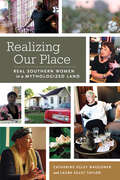
Realizing Our Place: Real Southern Women in a Mythologized Land
by Catherine Egley Waggoner Laura Egley TaylorWhat does it mean to be from somewhere? Does place seep into one's very being like roots making their way through rich soil, shaping a sense of self? In particular, what does it mean to be from a place with a storied past, one mythologized as the very best and worst of our nation? Such questions inspired Catherine Egley Waggoner and Laura Egley Taylor, sisters and Delta expatriates themselves, to embark on a trail of conversations through the Mississippi Delta.Meeting in evocative settings from kitchens and beauty parlors to screened-in porches with fifty-one women--black, Chinese, Lebanese, and white; elderly and young; rich and poor; bisexual and straight--the authors trace the extent to which the historical dimensions of southern womanhood like submissiveness, purity, piety, and domesticity are visible in contemporary Delta women's everyday enactments. Waggoner and Taylor argue that these women do not simply embrace or reject such dimensions, but instead creatively tweak stereotypes in such a way that skillfully legitimizes their authenticity.Blending academic analysis with colorful excerpts of Delta women's words and including over one hundred striking photographs, Waggoner and Taylor provide an insightful peek into the lives of real southern women living in a deeply mythologized land.
Realizing Value in Mesoamerica: The Dynamics of Desire and Demand in Ancient Economies (Palgrave Studies in Ancient Economies)
by Charles Golden Scott R. HutsonThis edited collection addresses concepts of value and its impact on economies and economic decision-making in Mesoamerica. It brings together various theoretical and methodological approaches to illuminate the little-studied topic of value in ancient economies.While scholars increasingly note that tangible objects found in the archaeological record could assume different values, depending on how they were used and circulated, less attention has been paid to how we might infer consensus (or lack of consensus) on how value was determined in past cultures so different from contemporary ones. These contributions show how multiple and conflicting understandings of what is important and meaningful coexist within any society even as moments of exchange create the impression of shared formulations of value. They consider divergences between shared understandings based on systems of beliefs and patterns of practice and the individual decisions of social actors. They also discuss how inequalities in social structures might inform our understanding of value, and how a multiplicity of values might encourage closer inspection of inequality in turn.The book brings together fifteen chapters focused on many parts of Mesoamerica, including Western Mexico, the Basin of Mexico, Veracruz, Oaxaca, and various parts of the Maya Lowlands, and range chronologically from the Classic period (250-900 CE) to the Spanish Conquest in the early 16th Century. It appeals to those working in archaeology, economic anthropology, economic history, and all those interested in how value can be understood in terms of contemporary cultural and political differences.
Realizing the Potential of Immigrant Youth
by Donald J. Hernandez Ann S. Masten Karmela LiebkindThe well-being and productivity of immigrant youth has become one of the most important global issues of our times as a result of mass migration and resettlement. In this unique volume, leading scholars from multiple nations and disciplines provide a state-of-the-art overview of contemporary research on immigrant youth and delineate the most promising future directions for research on their success, suggesting implications for policy and interventions that will benefit host societies as well as immigrant youth. The contributors to Realizing the Potential of Immigrant Youth include many of the leading international experts on migration, acculturation, intergroup issues, and immigrant youth development, with contributions from the fields of child development, demography, economics, education, immigrant mental health, social psychology, and sociology.
Realizing the Potential of the American Community Survey: Challenges, Tradeoffs, and Opportunities
by Panel on Addressing Priority Technical Issues for the Next Decade of the American Community SurveyThe American Community Survey (ACS) was conceptualized as a replacement to the census long form, which collected detailed population and housing data from a sample of the U. S. population, once a decade, as part of the decennial census operations. The long form was traditionally the main source of socio-economic information for areas below the national level. The data provided for small areas, such as counties, municipalities, and neighborhoods is what made the long form unique, and what makes the ACS unique today. Since the successful transition from the decennial long form in 2005, the ACS has become an invaluable resource for many stakeholders, particularly for meeting national and state level data needs. However, due to inadequate sample sizes, a major challenge for the survey is producing reliable estimates for smaller geographic areas, which is a concern because of the unique role fulfilled by the long form, and now the ACS, of providing data with a geographic granularity that no other federal survey could provide. In addition to the primary challenge associated with the reliability of the estimates, this is also a good time to assess other aspects of the survey in order to identify opportunities for refinement based on the experience of the first few years. "Realizing the Potential of the American Community Survey" provides input on ways of improving the ACS, focusing on two priority areas: identifying methods that could improve the quality of the data available for small areas, and suggesting changes that would increase the survey's efficiency in responding to new data needs. This report considers changes that the ACS office should consider over the course of the next few years in order to further improve the ACS data. The recommendations of "Realizing the Potential of the American Community Survey" will help the Census Bureau improve performance in several areas, which may ultimately lead to improved data products as the survey enters its next decade.