- Table View
- List View
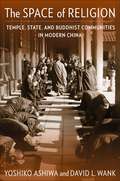
The Space of Religion: Temple, State, and Buddhist Communities in Modern China (The Sheng Yen Series in Chinese Buddhist Studies)
by Yoshiko Ashiwa David L. WankThe Nanputuo Temple in the southeastern Chinese city of Xiamen has been a cherished site for the worship of the bodhisattva Guanyin for centuries. It was a center of modernizing Buddhism in the early twentieth century and a flagship for the revival of Buddhism after state suppression during the Cultural Revolution. The Space of Religion takes readers inside the Nanputuo Temple in order to explore the practice of Buddhism in modern China and the complex relationship between Buddhism and the Chinese state.Based on three decades of ethnographic research, Yoshiko Ashiwa and David L. Wank tell the story of Nanputuo against the backdrop of a dramatic stretch of Chinese history. They vividly depict episodes such as renovating the halls, reestablishing ties with overseas Chinese donors, conflicts with local government, revival of ritual life, reopening of its Buddhist academy, and the passion of the Guanyin birthday festival. To understand Nanputuo, Buddhist communities, and other temples in Xiamen, Ashiwa and Wank develop the concept of religion as a space constituted by physical, semiotic, and institutional dimensions. They also show how the Chinese state and Buddhism have each adapted to the other, as the temple has adjusted to government policy while the state has deployed Buddhism in its promotion of Chinese culture.This interdisciplinary book is both a theoretically generative analysis of religious spaces and an empirically rich account of the recovery of Buddhism in China after the Mao era.
The Space of the World: Can Human Solidarity Survive Social Media and What If It Can't?
by Nick CouldryOver the past thirty years, humanity has made a huge mistake. We handed over to big tech decisions that have allowed them to build what has become our "space of the world" – the highly artificial space of social media platforms where much of our social life now unfolds. This has proved reckless and has huge social consequences.The toxic effects on social life, young people’s mental health, and political solidarity are well known, but the key factor underlying all this has been missed: the fact that humanity allowed business to construct our space of the world at all and then exploit it for profit. In the process, we ignored two millennia of political thought about the conditions under which a healthy or even a non-violent politics is possible. We endangered the one resource that is in desperately short supply in the face of catastrophic climate change: solidarity. Is human solidarity possible in a world of continuous digital connection and commercially managed platforms, and what if it isn’t?In the first book of his trilogy, Humanising the Future, Nick Couldry offers a radical new vision of how to design our digital spaces so that they build, rather than erode, both solidarity and community. This trenchant and vividly written book stresses that we cannot afford not to care for our space of the world. We need to rebuild it together.
The Space that Separates: A Critical Realist Aesthetics (Routledge Studies in Critical Realism)
by Nick WilsonThe Space that Separates: A Realist Theory of Art radically challenges our assumptions about what art is, what art does, who is doing it, and why it matters. Rejecting the modernist and market-driven misconception that art is only what artists do, Wilson instead presents a realist case for living artfully. Art is defined as the skilled practice of giving shareable form to our experiences of being-in-relation with the real; that is to say, the causally generative domain of the world that extends beyond our direct observation, comprising relations, structures, mechanisms, possibilities, powers, processes, systems, forces, values, ways of being. In communicating such aesthetic experience we behold life’s betweenness – "the space that separates", so coming to know ourselves as connected. Providing the first dedicated and comprehensive account of art and aesthetics from a critical realist perspective – Aesthetic Critical Realism (ACR), Wilson argues for a profound paradigm shift in how we understand and care for culture in terms of our system(s) of value recognition. Fortunately, we have just the right tool to help us achieve this transformation – and it’s called art. Offering novel explanatory accounts of art, aesthetic experience, value, play, culture, creativity, artistic truth and beauty, this book will appeal to a wide audience of students and scholars of art, aesthetics, human development, philosophy and critical realism, as well as cultural practitioners and policy-makers.
The Spaces of Mental Capacity Law: Moving Beyond Binaries (Social Justice)
by Beverley CloughThis book explores the conceptual spaces and socio-legal context which mental capacity laws inhabit. It will be seen that these norms are created and reproduced through the binaries that pervade mental capacity laws in liberal legal jurisdictions- such as capacity/incapacity; autonomy/paternalism; empowerment/protection; carer/cared-for; disabled/non-disabled; public/private. Whilst on one level the book demonstrates the pervasive reach of laws questioning individuals mental capacity, within and beyond the medical context which it is most commonly associated with, at a deeper and perhaps more important level it challenges the underlying norms and assumptions underpinning the very idea of mental capacity, and reflects outwards on the transformative potential of these realisations for other areas of law. In doing so, whilst the book offers lessons for mental capacity law scholarship in terms of reform efforts at both domestic and internationals levels, it also offers ways to develop our understandings of a range of linked legal, policy and theoretical concepts. In so doing, it offers new critical vantage points for both legal critique and conceptual change beyond mental capacity law. The book will be of interest to researchers in mental capacity law, disability law and socio-legal studies as well as critical geographers and disability studies scholars.
The Spaces of Public Issues: How Social Media Discourses Shape Public Imaginations of Issue Spatiality (The Refiguration of Space)
by Daniela StoltenbergIdeas about matters of public concern are shaped by the spaces associated with them: Events occur in particular places, political regulations apply to specific territories, people in different locations are differentially affected by issues. Yet, political communication research has neglected the question of how the spaces of public issues are constructed in the public sphere. This is especially true for research on social media communication, which is often perceived as placeless. Yet, social media discourses are driven by unequal attention patterns based on users’ interests, resources, and abilities. To understand how these patterns manifest spatially, this interdisciplinary monograph builds on public spheres theory, communication infrastructure theory, and urban sociology to develop the framework of issue spatiality. It focuses on how social media users discuss different places in urban policy issue discourses. By applying the framework to four large-scale Twitter discourses on housing markets and cycling infrastructure in two German cities, Berlin and Frankfurt, the research reveals the spatial patterns and inequalities of social media discourses. It demonstrates that digital discourses are overwhelmingly focused on a small number of places in the urban center. These places emerge as the locus of activism and political controversy, while the urban periphery remains hidden or is discussed in purely administrative terms. Places with dense civic infrastructure and privileged residents receive disproportionate attention. The book provides an in-depth look at the ways in which socio-spatial inequalities are inscribed in public communication and shape ideas about societal issues.
The Spaces of the Modern City: Imaginaries, Politics, and Everyday Life (Publications in Partnership with the Shelby Cullom Davis Center at Princeton University #2)
by Gyan Prakash & Kevin M. KruseBy United Nations estimates, 60 percent of the world's population will be urban by 2030. With the increasing speed of urbanization, especially in the developing world, scholars are now rethinking standard concepts and histories of modern cities. The Spaces of the Modern City historicizes the contemporary discussion of urbanism, highlighting the local and global breadth of the city landscape. This interdisciplinary collection examines how the city develops in the interactions of space and imagination. The essays focus on issues such as street design in Vienna, the motion picture industry in Los Angeles, architecture in Marseilles and Algiers, and the kaleidoscopic paradox of post-apartheid Johannesburg. They explore the nature of spatial politics, examining the disparate worlds of eighteenth-century Baghdad, nineteenth-century Morelia, Cold War-era West Berlin, and postwar Los Angeles. They also show the meaning of everyday spaces to urban life, illuminating issues such as crime in metropolitan London, youth culture in Dakar, "memory projects" in Tokyo, and Bombay cinema. Informed by a range of theoretical writings, this collection offers a fresh and truly global perspective on the nature of the modern city. The contributors are Sheila Crane, Belinda Davis, Mamadou Diouf, Philip J. Ethington, David Frisby, Christina M. Jiménez, Dina Rizk Khoury, Ranjani Mazumdar, Frank Mort, Martin Murray, Jordan Sand, and Sarah Schrank.
The Spanish Fiscal Transition: Tax Reform and Inequality in the Late Twentieth Century (Palgrave Studies in Economic History)
by Sara Torregrosa HetlandThis book provides an analysis of the process and outcomes of the tax reform, with a focus on progressivity, redistribution, and inequality. Between 1977 and 1986, Spain underwent a comprehensive tax reform which shaped its fiscal system until today. It was made in connection with the transition to democracy and indeed was understood as a fundamental part of the political change. The book situates the reform both within Spanish history and international trends in tax systems and connects it to the expansion of the welfare state and regional decentralization in Spain. The analysis reveals that the tax system failed to attain progressivity, and significant levels of fraud had a noticeable impact on inequality. Because of this, fiscal redistribution remained limited. In the new political economy of the second globalization, late democratic and fiscal transitioners were unable to emulate the path of the welfare state forerunners.
The Spanish Language in the United States: Rootedness, Racialization, and Resistance (New Critical Viewpoints on Society)
by José A. CobasThe Spanish Language in the United States addresses the rootedness of Spanish in the United States, its racialization, and Spanish speakers’ resistance against racialization. This novel approach challenges the "foreigner" status of Spanish and shows that racialization victims do not take their oppression meekly. It traces the rootedness of Spanish since the 1500s, when the Spanish empire began the settlement of the new land, till today, when 39 million U.S. Latinos speak Spanish at home. Authors show how whites categorize Spanish speaking in ways that denigrate the non-standard language habits of Spanish speakers—including in schools—highlighting ways of overcoming racism.
The Spanx Story: What's Underneath the Incredible success of Sara Blakely's Billion Dollar Empire (The Business Storybook Series)
by Charlie Wetzel Stephanie WetzelWhat can you learn from one of the most successful companies in the world? The Spanx Story will help you understand and adopt the competitive strategies, workplace culture, and daily business practices that enabled entrepreneur Sara Blakely to dominate the shapewear industry and become a billionaire.Sara Blakely had a problem. She had a beautiful pair of white designer pants hanging in her closet just calling out to her to wear them, even though they accented her least favorite feature: cellulite. After searching high and low for a solution and coming up empty, an idea was born: Spanx.The Spanx Story chronicles Sara&’s journey from long nights researching patent and trademark law, to years of cold shoulders she received from the titans of the pantyhose industry, to the cold call that led to the shelves of Nieman Marcus. It was a long road of incredible hard work and determination that led Spanx to become the iconic brand it is today.Through Sara&’s story, you will learn:How to develop an idea and turn it into a business.How to start a company with very little capital by thinking outside of the box and dedicating every spare moment to your goal.How to recognize when it&’s better to hire a CEO than to be the CEO.How to stay the course and continue to believe in your idea, despite naysayers and going against an industry resistant to innovation.The Spanx Story educates and inspires entrepreneurs and innovators to find the problem for their solutions and persevere through the hard work that goes into building a billion-dollar company.
The Spare Room
by Helen GarnerIn this short but very direct novel, Helen Garner explores the question: how much of ourselves must we give up to help a friend in need? Helen has little idea what lies ahead--and what strength she must summon--when she offers her spare room to an old friend, Nicola, who has arrived in Melbourne from Sydney for cancer treatments and who is skeptical of the medical establishment, placing all her faith in an alternative health center. Nicola is determined to find her own way to cope, regardless of the advice Helen offers. In the weeks that follow, Nicola's battle for survival will turn not only her own life upside down but also those of everyone around her. Helen unexpectedly finds herself driven through extremes of rage and tenderness to become Nicola's nurse, protector, guardian angel, and stony judge. Powerful and taut, and full of wisdom and dark laughter, The Spare Room is a magical gem of a book that packs a huge punch.
The Spatial Logic of Informal Urbanism: Inventraset Assemblages
by Kim Dovey Redento B. RecioHighly informalized cities of the global South are often portrayed as chaotic and out of control - this book reveals a spatial logic of informal urbanism that is central to the economic life and livelihoods of such cities. 'Inventraset' is a concept that shows how informal street vending, transport and settlement are fundamentally integrated with each other and the more formal city. Street vending and transport provide crucial forms of employment and mobility, while informal settlement is the key source of affordable and adaptable housing. Informal urbanism is not ideal but it is the way such cities work; it is often hidden or camouflaged within the ideal of a clean, green and modern city to which middle-classes and elites aspire. Through comparative studies, with a focus on Manila and Jakarta, the book maps and analyzes how such cities work through alliances and synergies between vending, transport and settlement - inventraset assemblages are inventive and transgressive, yet settled.
The Spatial Turn: Interdisciplinary Perspectives (Routledge Studies in Human Geography)
by Barney Warf Santa AriasAcross the disciplines, the study of space has undergone a profound and sustained transformation. Space, place, mapping, and geographical imaginations have become commonplace topics in a variety of analytical fields in part because globalization has accentuated the significance of location. While this transformation has led to a renaissance in human geography, it also has manifested itself in the humanities and other social sciences. The purpose of this book is not to announce that space is significant, which by now is well known, but to explore how space is analyzed by a variety of disciplines, to compare and contrast these approaches, identify commonalities, and explore how and why differences appear. The volume includes works by 13 scholars from a variety of geographical regions and disciplines. The chapters combine up-to-date literature reviews concerning the role of space in each discipline and several offer original empirical analyses. Some chapters are concerned with Geography while others explore the role of space in contemporary Anthropology, Sociology, Religion, Political Science, Film, and Cultural Studies. The introduction surveys the development of the spatial turn across the fields under consideration. Despite frequent reference to the spatial turn, this is the first volume to explicitly address how theory and practice concerning space, is used in a variety of fields from diverse conceptual perspectives. This book will appeal to everyone conducting conceptual and theoretical research on space, not simply in Geography, but in related fields as well.
The Special Educator’s Guide to Behavior Management (Evidence-Based Instruction in Special Education)
by Paul Mooney Joseph B. RyanThis accessible, practitioner-focused textbook details a comprehensive classroom behavior management framework that is easy to understand and implement within a K-12 classroom. Influenced by decades of classroom teaching and special education teacher candidate preparation experiences, the book features effective evidence-based strategies designed to both prevent problem behaviors from occurring in classrooms and address challenging behaviors that presently exist or may arise.Each of the book’s four sections show readers step-by-step how to develop, implement, and evaluate a personalized behavior management plan that best meets the unique needs of their classrooms which can vary tremendously in both size and types of students served. From the first page to the last, this new text addresses the reader in a friendly, personal way in an effort to enhance accessibility and encourage them to want to understand the "what and how" of each strategy and/or process and how it relates to the overall behavioral framework laid out in section one.Ideal for both current and prospective special educators, this book supports readers in developing their own comprehensive approach to classroom behavior management that can be implemented across grade levels.
The Spectacle of Critique: From Philosophy to Cacophony (Contemporary Liminality)
by Tom BolandFar from being the preserve of a few elite thinkers, critique increasingly dominates public life in modernity, leading to a cacophony of accusation and denunciation around all political issues. The technique of unmasking ‘power’ or ‘hegemony’ or ‘ideology’ has now been adopted across the political spectrum, where critical discourses are routinely used to suggest that anything and everything is only a ‘construct’ or even a ‘conspiracy’. This book draws on anthropological theory to provide a different perspective on this phenomenon; critique appears as a liminal predicament combining imitative polemical and schismatic urges with a haunting sense of uncertainty. It thereby addresses a central academic concern, with a special focus on political critique in the public sphere and within social media. Combining historical interrogations of the roots of critique, as well as examining contemporary political discourse in relation to populism, as seen in presidential elections, historical commemorations and welfare reform, The Spectacle of Critique uses anthropology and genealogy to offer a new sociology of critique that problematises critique and diagnoses its crisis, cultivating acritical and imaginative ways of thinking.
The Spectacle of Expertise: Why Financial Analysts Perform in the Media
by Alex PredaFinancial experts have become ubiquitous on television, radio, and social media. They provide investment advice, interpret market movements, and explain the implications of political events, wielding a great deal of power and influence through their media presence. How do these experts acquire their authority, and what makes displays of financial expertise persuasive to their audiences?Alex Preda provides an ethnographic exploration of how financial expertise is performed and produced in the media, analyzing its features and how audiences react to it. He examines how analysts, anchors, and producers collaborate in manufacturing financial talk that circulates around the world. Preda emphasizes the significance of talk—as opposed to the written word—in finance, as the fabric of many transactions and a means of capturing capital. Analysts and media figures understand financial talk as requiring a skill set distinct from conducting research or representing facts. Preda demonstrates that analysts and media professionals deploy expertise when they engage with audiences in ways that make it difficult to contest the claims conveyed in their talk.The Spectacle of Expertise is based on close observations of TV and radio studios in Hong Kong, a global financial center and a crucial gateway to China, including interviews with audience members and financial analysts who appear as regular guests. It offers new and global perspectives on the relationship between financial expertise and the media, the making of public-expert talk, and how expertise is used to legitimize financialization.
The Spectacle of History: Speech, Text, and Memory at the Iran-Contra Hearings
by Michael E. Lynch David BogenHow is history produced? How do individuals write--or rewrite--their parts while engaged in the production of history? Michael Lynch and David Bogen take the example of the Iran-contra hearings to explore these questions. These hearings, held in 1987 by the Joint House-Senate Select Committee on Secret Military Assistance to Iran and the Nicaragua Opposition, provided the nation with a media spectacle and a rare chance to see a struggle over the writing of history. There was Oliver North, prime suspect and designated scapegoat, turning into a hero of the American Right before the very eyes of the nation. How this transformation occurred, with the complicity of the press and the public, becomes disturbingly clear in The Spectacle of History.Lynch and Bogen detail the practices through which the historical agents at the center of the hearings composed, confirmed, used, erased, and denied the historical record. They show how partisan skirmishes over the disclosure of records and testimony led to a divided and irresolute outcome, an outcome further facilitated by the "applied deconstruction" deployed by North and his allies. The Spectacle of History immerses the reader in a crowded field of texts, utterances, visual displays, and media commentaries, but, more than a case study, it develops unique insight into problems at the heart of society and social theory--lying and credibility, the production of civic spectacle, the relationship between testimony and history, the uses of memory, and the interplay between speech and writing.Drawing on themes from sociology, literary theory, and ethnomethodology and challenging prevailing concepts held by contemporary communication and cultural studies, Lynch and Bogen extract valuable theoretical lessons from this specific and troubling historical episode.
The Spectacle of Isolation in Horror Films: Dark Parades
by Carl Royer B Lee CooperGo behind the scenes with an insightful look at horror films-and the directors who create them The Spectacle of Isolation in Horror Films: Dark Parades examines the work of several of the genre&’s most influential directors and investigates how traditional themes of isolation, alienation, death, and transformation have helped build the foundation of horror cinema. Authors Carl and Diana Royer examine the techniques used by Alfred Hitchcock that place his work squarely in the horror (rather than suspense) genre, discuss avant-garde cinema&’s contributions to mainstream horror, explore films that use the apartment setting as the "cell of horror," and analyze how angels and aliens function as the supernatural "Other." A unique resource for film students and film buffs alike, the book also examines Sam Raimi&’s Evil Dead trilogy and the fusion of science, technology, and quasi-religious themes in David Cronenberg&’s films. Instead of presenting a general overview of the horror genre or an analysis of a specific sub-genre, actor, or director, The Spectacle of Isolation in Horror Films offers an imaginative look at classic and contemporary horror cinema. The book examines Surrealist films such as Un Chien Andalou and Freaks, the connections among the concepts of voyeurism, paranoia, and alienation in films like Rear Window, Rosemary&’s Baby, Blue Velvet, and The Blair Witch Project; the use of otherworldly creatures in films such as The Prophecy, Dogma, and The Day The Earth Stood Still; and the films of directors George Romero, John Waters, and Darren Aronofsky, to name just a few. This unique book also includes an extensive A-to-Z filmography and a bibliography of writings on, and about, horror cinema from filmmakers, film critics, and film historians. The Spectacle of Isolation in Horror Films examines: "Body Doubles and Severed Hands"-the common ancestry of avant-garde "art" films and exploitation horror B-movies "And I Brought You Nightmares"-recurring themes of psychological terror in Alfred Hitchcock&’s films "Horror, Humor, Poetry"-Sam Raimi&’s transformation of "drive-in" horror cinema "Atheism and 'The Death of Affect'"-David Cronenberg&’s obsessions, interests, and cautionary messages in films ranging from Videodrome to Dead Ringers to eXistenZ and much more!The Spectacle of Isolation in Horror Films: Dark Parades is a unique resource of critical analysis for academics working in film and popular culture, film historians, and anyone interested in horror cinema.
The Spectacle of Politics and Religion in the Contemporary Turkish Cinema
by Ebru Thwaites DikenThis book explores how politics, religion and cinema encounter and re-invent each other in contemporary Turkish cinema. It investigates their common origin—the spectacle, which each field views as an instrument of governmentality. The book analyses six recent, some of which are internationally known Turkish films: The Messenger (Ulak), A Man’s Fear of God (Takva), Let’s Sin (İtirazım Var), SixtyOne Days (İftarlık Gazoz), The Imam and The Shadowless (Gölgesizler). Thwaites discusses how the cinematic nature of politics and religion unfold amidst the increasing media visibility of religion in contemporary Turkey. The chapters explore the relationship between art and religion, and compare religion and philosophy in their relation to truth, belief, and economy. Through close examination of these films, the author highlights the role of cinema in contemporary Turkey and at the heart of the religious paradigm.
The Spectacular City: Violence and Performance in Urban Bolivia
by Daniel M. GoldsteinSince the Bolivian revolution in 1952, migrants have come to the city of Cochabamba, seeking opportunity and relief from rural poverty. They have settled in barrios on the city's outskirts only to find that the rights of citizens--basic rights of property and security, especially protection from crime--are not available to them. In this ethnography, Daniel M. Goldstein considers the significance of and similarities between two kinds of spectacles--street festivals and the vigilante lynching of criminals--as they are performed in the Cochabamba barrio of Villa Pagador. By examining folkloric festivals and vigilante violence within the same analytical framework, Goldstein shows how marginalized urban migrants, shut out of the city and neglected by the state, use performance to assert their national belonging and to express their grievances against the inadequacies of the state's official legal order. During the period of Goldstein's fieldwork in Villa Pagador in the mid-1990s, residents attempted to lynch several thieves and attacked the police who tried to intervene. Since that time, there have been hundreds of lynchings in the poor barrios surrounding Cochabamba. Goldstein presents the lynchings of thieves as a form of horrific performance, with elements of critique and political action that echo those of local festivals. He explores the consequences and implications of extralegal violence for human rights and the rule of law in the contemporary Andes. In rich detail, he provides an in-depth look at the development of Villa Pagador and of the larger metropolitan area of Cochabamba, illuminating a contemporary Andean city from both microethnographic and macrohistorical perspectives. Focusing on indigenous peoples' experiences of urban life and their attempts to manage their sociopolitical status within the broader context of neoliberal capitalism and political decentralization, The Spectacular City highlights the deep connections between performance, law, violence, and the state.
The Spectacular Few: Prisoner Radicalization and the Evolving Terrorist Threat (Alternative Criminology #13)
by Mark S. HammThe Madrid train bombers, shoe-bomber Richard Reid, al-Qaeda in Iraq, and the 9/11 attacks—all were led by men radicalized behind bars. By their very nature, prisons are intended to induce transformative experiences among inmates, but today’s prisons are hotbeds for personal transformation toward terrorist beliefs and actions due to the increasingly chaotic nature of prison life caused by mass incarceration. In The Spectacular Few, Mark Hamm demonstrates how prisoners use criminal cunning, collective resistance and nihilism to incite terrorism against Western targets. A former prison guard himself, Hamm knows the realities of day-to-day prison life and understands how prisoners socialize, especially the inner-workings and power of prison gangs—be they the Aryan Brotherhood or radical Islam. He shows that while Islam is mainly a positive influence in prison, certain forces within the prison Muslim movement are aligned with the efforts of al-Qaeda and its associates to inspire convicts in the United States and Europe to conduct terrorist attacks on their own. Drawing from a wide range of sources—including historical case studies of prisoner radicalization reaching from Gandhi and Hitler to Malcolm X, Bobby Sands and the detainees of Guantanamo; a database of cases linking prisoner radicalization with evolving terrorist threats ranging from police shootouts to suicide bombings; interviews with intelligence officers, prisoners affiliated with terrorist groups and those disciplined for conducting radicalizing campaigns in prison—The Spectacular Few imagines the texture of prisoners’ lives: their criminal thinking styles, the social networks that influenced them, and personal “turning points” that set them on the pathway to violent extremism. Hamm provides a broad understanding of how prisoners can be radicalized, arguing that in order to understand the contemporary landscape of terrorism, we must come to terms with how prisoners are treated behind bars.
The Specter of Hypocrisy: Testing the Limits of Moral Discourse
by Raphael SassowerRaphael Sassower examines the concept of hypocrisy for its strategic potential as a means of personal protection and social cohesion. Given the contemporary context of post-truth, the examination of degrees or kinds of hypocrisy moves from the Greek etymology of masks worn on the theater stage to the Hebrew etymology of the color adjustment of chameleons to their environment. Canonical presuppositions about the uniformity of the mind and the relation between intention and behavior that warrant the charge of hypocrisy are critically reconsidered in order to appreciate both inherent inconsistencies in personal conduct and the different contexts where the hypocrisy appears. Sassower considers the limits of analytic moral and political discourses that at times overlook the conditions under which putative hypocritical behavior is existentially required and where compromises yield positive results. When used among friends, the charge of hypocrisy is a useful tool with which to build trust and communities.
The Specter of Salem: Remembering the Witch Trials in Nineteenth-Century America
by Gretchen A. AdamsIn this book, the author reveals the many ways that the Salem witch trials loomed over the American collective memory from the Revolution to the Civil War and beyond. Schoolbooks in the 1790s, for example, evoked the episode to demonstrate the new nation's progress from a disorderly and brutal past to a rational present, while critics of new religious movements in the 1830s cast them as a return to Salem-era fanaticism, and during the Civil War, southerners evoked witch burning to criticize Union tactics. Shedding new light on the many, varied American invocations of Salem, the author ultimately illuminates the function of collective memories in the life of a nation. "Imaginative and thoughtful. Thought-provoking, informative, and convincingly presented, this book is an often spellbinding mix of politics, cultural history, and public historiography."-- New England Quarterly "This well-researched book, forgoing the usual heft of scholarly studies, is not another interpretation of the Salem trials, but an important major work within the scholarly literature on the witch-hunt, linking the hysteria of the period to the evolving history of the American nation. A required acquisition for academic libraries."--Choice, Outstanding Academic Title 2009
The Spectral Within: Fascism, New Towns and their Contemporary Lives (New Anthropologies of Europe: Perspectives and Provocations)
by Elena MiltiadisLatina was founded in 1932 by the Fascist Regime and is often described by its inhabitants through its absences, as a place where there is ‘nothing’. The book examines the role of absence in place-making and delves into the lived experience of Latina. Through the analytical lens of haunting, this work explores its inhabitants’ efforts to see their city as a meaningful social space, as they navigate its multiple histories and the absent presence of the contested past.
The Speculations of Country People
by Majella Kelly'Ruminative and enigmatic . . . powerful' Simon Armitage'Tenderly inquisitive . . . a powerful poetry of witness . . . full of discovery' Alycia Pirmohamed'Majella Kelly offers so much: ecstatic lyricism . . . emotional excavation and virtuosic skill' Kathryn Maris The astonishing poetry debut exploring hidden histories, mythical landscapes and self-discovery in the face of limits on women's bodily autonomyIn 2017, the presence of a mass grave was confirmed in a disused sewage system in Tuam, County Galway. In it were the bodies of infants - wards of the Bon Secours Mother and Baby Home, where from 1925 to 1961 the children of unmarried women were sent to live their lives in the care of nuns. Their deaths were the result of a conservative culture which, under the influence of the Church, took a prurient interest in women's private lives and bodies.In The Speculations of Country People, her hauntingly lyrical debut collection, Majella Kelly reckons with that legacy. She traces the journeys of women in our own day, from controlling relationships to sexual reawakening and new happiness. The speculations of the title are in part those of gossip, the chatter of small communities everywhere; but they are also those of a local, very Irish mythos, in which pagan and Christian - and truth and legend - blend and blur.Here, then, are hares and selkies, a seductive 'master otter' of 'fabulous elegance' who might carry a woman away in the night; here is the last man on Omey Island; here a retired stuntman, dragging his bed of rusty nails along the beach. And here - quiet, against the beauty and loneliness of the Connemara landscape - are the little bones that wash up on shores or stick from the earth to speak of what has been.

The Speculative City: Art, Real Estate, and the Making of Global Los Angeles
by Susanna Phillips NewburyA forensic examination of the mutual relationship between art and real estate in a transforming Los Angeles Underlying every great city is a rich and vibrant culture that shapes the texture of life within. In The Speculative City, Susanna Phillips Newbury teases out how art and Los Angeles shaped one another&’s evolution. She compellingly articulates how together they transformed the Southland, establishing the foundation for its contemporary art infrastructure, and explains how artists came to influence Los Angeles&’s burgeoning definition as the global city of the twenty-first century.Pairing particular works of art with specific innovations in real estate development, The Speculative City reveals the connections between real estate and contemporary art as they constructed Los Angeles&’s present-day cityscape. From banal parking lots to Frank Gehry&’s designs for artists&’ studios and museums, Newbury examines pivotal interventions by artists and architects, city officials and cultural philanthropists, concluding with an examination of how, in the wake of the 2008 global credit crisis, contemporary art emerged as a financial asset to fuel private wealth and urban gentrification. Both a history of the transformation of the Southland and a forensic examination of works of art, The Speculative City is a rich complement to the California chronicles by such writers as Rebecca Solnit and Mike Davis.